A handwashing fixture that delivers only lukewarm water at peak use can create a punch-list problem long after the plumbing rough-in is complete. A properly selected commercial electric tankless water heater avoids that outcome by matching real demand, incoming water conditions, and available electrical capacity – not simply by fitting a catalog description.
For contractors, facility teams, modular manufacturers, and government-project buyers, the decision is usually tied to more than hot water. It affects feeder sizing, panel capacity, fixture compliance, commissioning, submittals, maintenance access, and the schedule for receiving approved material. The right unit can provide point-of-use hot water with minimal standby loss and no tank footprint. The wrong unit can leave a facility with inadequate temperature rise during its busiest period.
Where Electric Tankless Units Fit Best
Commercial electric tankless heaters heat water only when flow is detected. Instead of storing a volume of heated water, they use electric heating elements and controls to deliver a specified temperature rise at a given flow rate. This makes them especially practical where demand is intermittent, distributed, or limited to a small fixture group.
Common applications include remote restroom groups, single commercial lavatories, guard stations, concession areas, break rooms, mobile or modular units, and supplemental hot-water locations far from a central plant. They are also useful where a large recirculation loop would add excessive pipe run, heat loss, and installation cost.
The best fit is not always the smallest fixture. A unit serving one lavatory in a conditioned building may need modest capacity, while a multi-fixture restroom served by cold incoming water may require substantially more kW than expected. Conversely, a high-demand kitchen, locker room, shower area, or process application may be better served by a central storage, hybrid, or multiple-unit design. Tankless equipment is a tool for a defined load, not a universal replacement for every commercial water-heating system.
Start With Demand and Temperature Rise
The most common specification error is selecting equipment by a nominal gallons-per-minute rating without examining the temperature rise behind that rating. Flow capacity changes with incoming water temperature and the outlet setpoint. A heater that appears adequate at a 40-degree temperature rise may not maintain the required outlet temperature when winter incoming water is much colder.
Start with the fixture load and expected simultaneous use. A single lavatory can often be evaluated differently from a restroom with several sensor faucets likely to operate at the same time. Consider actual fixture flow rates, occupancy patterns, usage duration, and whether the system is intended to supply tempered water only or hotter water for downstream mixing.
Then establish the design temperature rise. If incoming water is 45 degrees Fahrenheit and the required outlet is 105 degrees, the heater must provide a 60-degree rise at the design flow. If incoming water is 65 degrees, the same fixture demand requires far less input. For projects with broad seasonal conditions, size to the lowest credible inlet-water temperature rather than average conditions.
A simplified electrical relationship helps explain why this matters: higher flow and higher temperature rise require more kW. That kW requirement drives electrical service, conductor sizing, overcurrent protection, disconnect requirements, and available panel space. It should be coordinated before finalizing the equipment schedule, particularly on renovation work where electrical capacity may already be constrained.
Do Not Overlook Fixture Temperature Controls
A tankless heater’s outlet setting is not the same as delivered fixture temperature. Scald protection, thermostatic mixing requirements, local plumbing code, and facility standards still apply. Where a heater supplies multiple fixtures, verify whether point-of-use mixing, a master mixing valve, or a specific control strategy is required.
For public and institutional work, this coordination is especially important. The approved fixture package, accessibility requirements, sensor faucet settings, and hot-water delivery temperatures must work as a system. A correctly sized heater cannot compensate for a poorly coordinated temperature-control design.
Electrical Coordination Is Part of the Water Heater Selection
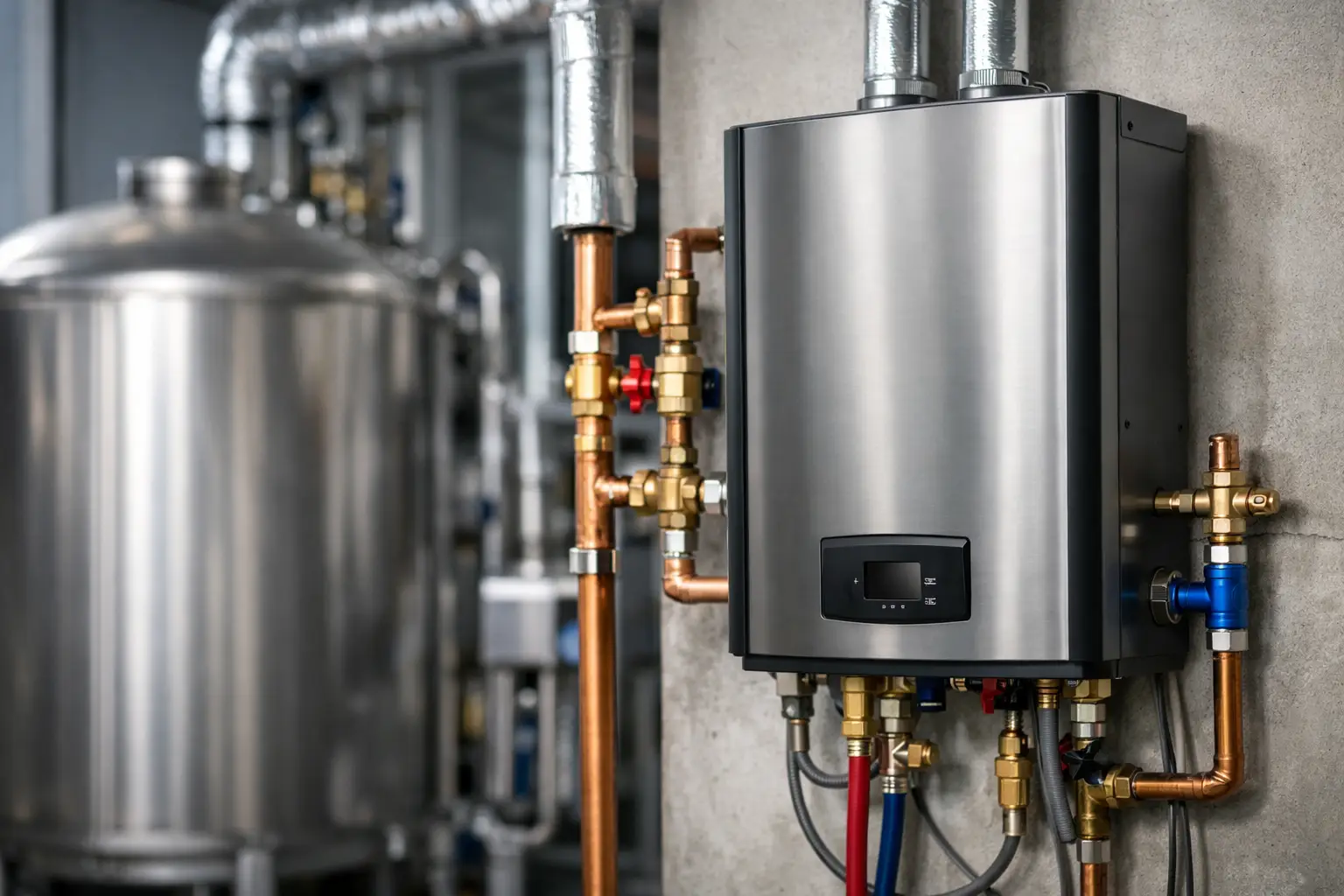
A commercial electric tankless water heater may appear compact on the wall, but its electrical demand can be significant. Larger units can require high-amperage, multi-circuit, three-phase service. The plumbing and electrical scopes need a shared understanding of the selected model before material is released.
Confirm the voltage, phase, frequency, total kW, number of circuits, and required breakers shown in the manufacturer data. Verify whether the project has 208V, 240V, 277V, or 480V service, and do not assume a unit rated for one voltage can simply be substituted for another. Output performance may also vary by voltage.
Physical installation details deserve the same attention. Confirm wall structure, clearances for service, location of electrical connections, required disconnecting means, pipe connection size, pressure limitations, and access to isolation valves. On modular projects, these details must align with the assembly sequence and final field connections. A unit that is technically specified but cannot be serviced after installation creates a predictable maintenance issue.
Selecting Controls and Construction for the Application
Not all electric tankless heaters use the same control approach. Basic units may stage elements to maintain a selected temperature range. More advanced models use electronic control to modulate output and provide tighter temperature stability across changing flow conditions. The right choice depends on the application, the required delivery consistency, and the consequences of low-flow cycling or fluctuating inlet temperature.
For handwashing applications, low-flow activation and stable operation at sensor-faucet flow rates should be reviewed carefully. For industrial or process-adjacent uses, consider the specified operating range, maximum outlet temperature, pressure rating, and water-quality conditions. Hard water, sediment, and aggressive water chemistry can affect element life and maintenance intervals. Where water conditions are known to be challenging, address treatment and service planning before turnover rather than after failures begin.
Also review enclosure rating and installation environment. A mechanical room, exterior enclosure, wet service area, and healthcare facility can each present different requirements for protection, access, noise expectations, and maintenance practices.
Documentation Matters on Regulated Projects
On Milcon, federal, municipal, education, and healthcare work, an acceptable heater is more than a model number. The submittal package may need manufacturer cut sheets, electrical characteristics, dimensional data, certifications, warranty information, compliance statements, and clear identification of the proposed configuration.
Avoid submitting a generic product family sheet when the project needs a specific voltage, kW input, mounting arrangement, or accessory package. Review the schedule against the manufacturer selection data and the electrical drawings. If a substitution is necessary because of availability or lead time, compare the operating performance and installation requirements line by line. A substitute that changes circuit count or required electrical capacity can affect more trades than the plumbing package.
Experienced procurement teams also account for long-lead risks before the job is ready for trim. Approved material, documented alternates, and accurate release information protect the schedule better than a last-minute search for a similar-looking unit.
Procurement Checks Before Release
Before ordering, verify the complete requirement rather than only the heater body. A commercial installation may require mounting hardware, valves, mixing equipment, strainers, unions, electrical disconnects, or manufacturer-specified accessories. Determine what is factory included, what is field furnished, and which trade owns each item.
For recurring facility work or production-line manufacturing, standardizing approved models can reduce both inventory complexity and service uncertainty. That does not mean using one model everywhere. It means establishing a controlled set of equipment options for known load profiles, voltages, and installation conditions.
Clarke Plumbing Specialties supports commercial buyers who need to source specified plumbing equipment with the documentation and job information required to keep work moving. When availability is tight, early communication about the exact project requirement gives the supply team a better path to identify compliant options and avoid avoidable revisions.
Plan for Service Before the Wall Is Closed
Tankless heaters eliminate tank maintenance, but they do not eliminate maintenance. Elements, screens, controls, connections, and valves still need inspection and service. Leave access for technicians to remove covers, isolate the water supply, verify electrical components, and flush the unit where manufacturer guidance and water conditions warrant it.
Label circuits and valves clearly. Keep approved product data with the closeout package. For facility teams, these small turnover details shorten troubleshooting time when a complaint arrives months or years after occupancy.
The strongest specification is the one that considers the hot-water load, electrical reality, code requirements, approval package, and service path together. Make those decisions early, and the heater becomes a dependable part of the building operation instead of a late-stage coordination issue.