

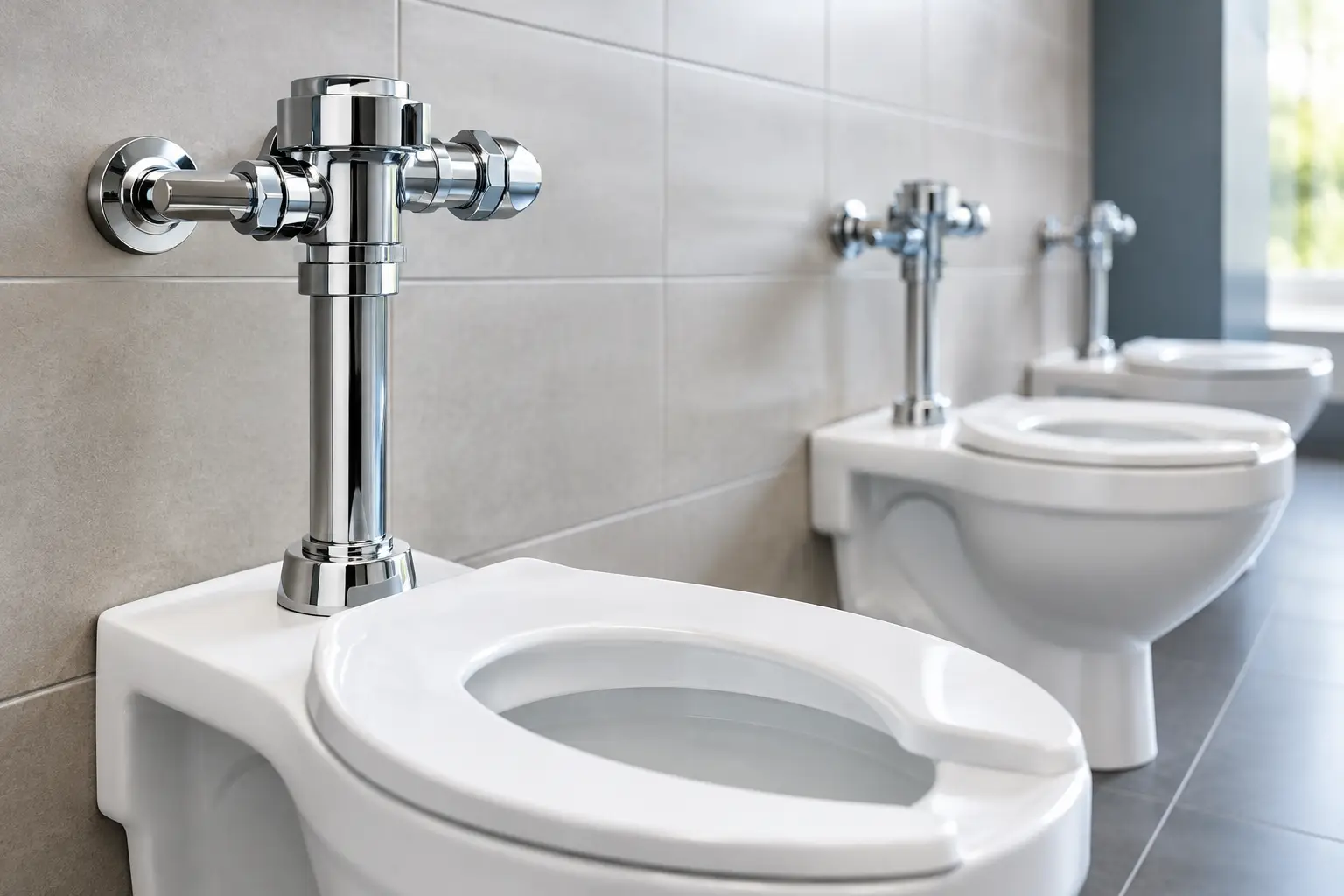
A flush valve can be a small line item in a restroom schedule and still create an outsized problem when it is specified incorrectly. A mismatched flush volume, incompatible fixture, missing trim option, or unavailable repair part can hold up rough-in, final trim, inspection, or turnover. The best commercial flush valves are not simply the most expensive models. They are the valves that match the fixture, water conditions, user traffic, code requirements, maintenance capabilities, and procurement documentation for the job.
For contractors, facility teams, modular manufacturers, and government project buyers, selection should start with operating requirements rather than a catalog image. A dependable valve is one that performs consistently under actual site conditions and can be serviced without creating a recurring facilities problem.
Best Commercial Flush Valves Start With Fixture Compatibility
The first decision is whether the valve is intended for a water closet or urinal, followed by the specific fixture manufacturer and bowl or urinal performance requirements. Flush valves are engineered around a defined volume and flow profile. Installing a valve with the wrong diaphragm, piston, or control stop setting can lead to weak evacuation, splash, double flushing, or excessive water use.
For water closets, 1.28 gallons per flush is common in commercial applications, but it is not a universal answer. Some specified fixtures require 1.6 gallons per flush, while high-efficiency combinations may use lower volumes when tested as a complete fixture-and-valve system. Urinal applications often use 0.5 gallons per flush, 0.125 gallons per flush, or another approved volume based on the fixture and local requirements.
Do not assume that a nominal flush volume makes two valves interchangeable. The fixture manufacturer’s listed valve pairing, inlet size, and pressure range should govern the selection. This matters especially when replacing older equipment. A new low-flow valve installed on an existing fixture may not deliver acceptable performance unless the combination has been evaluated for that purpose.
Manual, Sensor, and Battery-Powered Options
Manual flushometers remain a practical choice for many commercial restrooms. They are familiar to users and maintenance staff, have no electronic control components, and are well suited to facilities that want straightforward serviceability. In high-traffic schools, industrial sites, public buildings, and many institutional restrooms, a properly specified manual valve can provide years of dependable operation.
Sensor-operated valves make sense where touch-free activation is required by the owner, where hygiene expectations are high, or where facilities want more controlled flushing behavior. They are common in healthcare, hospitality, airports, offices, and public-facing restrooms. Their trade-off is that electronics, power supply, sensor adjustment, and replacement parts must be considered at the start of the project.
Hardwired sensor valves reduce battery replacement demands, but they require coordination with electrical work and access to power. Battery-powered valves can simplify installation and provide useful flexibility in renovation work, although facility teams need a defined battery maintenance plan. Some applications use hybrid systems that can operate with hardwired power while retaining battery backup.
The right choice depends on the owner’s maintenance model. A large facility with scheduled preventive maintenance may be comfortable managing electronic valve components. A remote facility or production environment with limited maintenance access may place more value on a proven manual configuration. Neither approach is automatically better. The valve has to fit the building’s operating reality.
Match the Valve to Water Pressure and Piping Conditions
Commercial flush valves depend on available pressure and flow. Before selecting a model, confirm static and flowing pressure at the fixture branch, pipe sizing, supply layout, and expected simultaneous demand. A valve that works properly during a single-fixture test may perform poorly when a restroom bank sees peak use.
Low-pressure conditions deserve particular attention. Some valves are designed to operate across a broad pressure range, while others need higher pressure to deliver the intended flush. Where pressure is marginal, simply increasing the control stop is not a reliable fix. It can create excessive flow, noise, and water waste without resolving the underlying supply issue.
Supply piping and water quality also affect long-term service. Debris from new construction, scale, or sediment can interfere with internal components. The installation should include proper flushing of lines before final valve assembly, and the control stop should remain accessible for adjustment and isolation. On renovation projects, inspect existing stops, vacuum breakers, tailpieces, and spud connections instead of assuming they can be reused.
Exposed Versus Concealed Flush Valves
Exposed flush valves are common because they are accessible, economical, and familiar to service personnel. They work well in most commercial restroom installations, particularly where maintenance speed matters. Their visible chrome finish also suits many public and institutional designs.
Concealed valves can provide a cleaner architectural appearance and may help protect components from tampering. However, they require careful coordination of carriers, wall construction, access panels, and service clearances. Concealed installation should not mean concealed maintenance. If the valve cannot be accessed efficiently, a minor repair can become a wall-opening event.
For correctional, transportation, school, and other high-abuse environments, vandal-resistant trim and tamper-resistant components may be appropriate. Those features should be selected based on the actual risk profile, not added automatically to every project. They can improve durability, but they may also affect initial cost and service procedures.
Specification Details That Affect Approval and Inspection
Commercial flush valve submittals need more than a finish designation and flush volume. Project teams should verify the valve type, fixture compatibility, inlet and outlet dimensions, control stop configuration, vacuum breaker requirements, power method where applicable, and listed compliance information required by the contract documents.
Accessibility requirements also affect the final configuration. Handle location, operating force, mounting height, and clear floor space are part of restroom coordination. A compliant valve can still create a field problem if it is installed where partitions, grab bars, accessories, or door swings interfere with operation.
For government and military construction work, documentation discipline is as important as physical product selection. The specified manufacturer, approved equal process, domestic preference requirements where applicable, finish, water-use criteria, and submittal data must align before material is released. A substitution that appears equivalent on paper can create avoidable approval delays if certifications, testing data, or required product attributes are missing.
Procurement teams should also confirm whether the design calls for complete valves, repair kits, stop caps, actuator components, or specialty trim. Ordering a base valve without a required component is one of the fastest ways to turn a routine trim package into an urgent expediting request.
Serviceability Is Part of the Purchase Decision
A flush valve is not finished when it passes inspection. It will eventually need diaphragms, pistons, seals, batteries, sensor parts, or rebuilding components. Selecting widely supported commercial product lines can reduce downtime later, particularly across multi-building campuses, school districts, healthcare systems, and national facility portfolios.
Standardization helps. When a facility uses a limited number of valve platforms, maintenance teams can stock fewer repair kits, train technicians more easily, and diagnose common issues faster. That does not mean forcing one valve into every application. It means using consistency where fixture requirements and owner standards allow it.
Consider the repair environment as well. A valve in a busy airport restroom needs quick shutoff, readily available service parts, and a repair procedure that does not close the restroom for long. A valve in a secure government facility may require approved components, controlled access, and more formal maintenance records. The best product decision accounts for both situations.
A Practical Buying Checklist for Commercial Projects
Before releasing an order, confirm these items across the fixture schedule, plumbing drawings, and submittal package:
- Water closet or urinal application, including the exact fixture model and approved flush volume.
- Manual, sensor, battery-powered, hardwired, or hybrid actuation required by the design and owner preference.
- Available water pressure, supply pipe conditions, inlet size, outlet connection, and control stop arrangement.
- Exposed or concealed installation, including carrier, wall, trim, and maintenance-access coordination.
- Required compliance documentation, accessibility criteria, finish, vandal resistance, and project-specific approvals.
- Replacement-part availability and whether the owner needs attic stock or maintenance kits at turnover.
This review takes less time than correcting an installed mismatch. It also gives procurement personnel a clear basis for comparing proposed alternates without relying on incomplete descriptions.
Buy for the Conditions You Actually Have
The best commercial flush valve for a high-traffic school restroom may be a serviceable manual model with a proven repair kit. For a healthcare renovation, touch-free actuation and controlled flush performance may take priority. For a Milcon or public-sector package, the deciding factor may be whether every required document and approval can be supplied on schedule.
Clarke Plumbing Specialties works with commercial buyers who cannot afford material gaps at trim-out or delayed paperwork in the approval cycle. Start with the fixture and project requirements, verify the full valve configuration, and secure the documentation and service parts that keep the restroom operating after turnover. That is how a flush valve becomes dependable jobsite material instead of a late-stage problem.



Leave A Comment