A bottle filler that looks compliant in a catalog can still create an inspection issue once it is mounted above the wrong fountain, placed outside reach range, or installed without the required approach space. ADA bottle filling station requirements should be reviewed as part of the complete drinking-water installation, not treated as a single mounting-height dimension. For contractors, facility teams, and procurement staff, that means coordinating the fixture, wall condition, rough-in, surrounding circulation, and governing code before material is released.
Start With the Applicable Accessibility Standard
The 2010 ADA Standards for Accessible Design establish federal accessibility requirements for many public accommodations and government facilities. Most commercial projects also fall under a state or local building code, commonly based on the International Building Code and ICC A117.1. Federal facilities may have additional requirements in the project specifications, agency criteria, or architectural accessibility standards.
These documents overlap, but they are not interchangeable. The strictest applicable requirement controls, and the authority having jurisdiction makes the final call on how the installation is evaluated. A school renovation, airport terminal, VA project, military installation, and private office building may all have different scoping, submittal, and inspection expectations.
The practical starting point is to identify whether the bottle filling station is an accessory mounted with a drinking fountain, a standalone water dispenser, or part of a combined high-low fountain assembly. That distinction affects which portions of the accessibility standard apply and whether the proposed equipment helps satisfy the required number of accessible drinking fountains.
What ADA Bottle Filling Station Requirements Cover
ADA standards do not set out a separate, stand-alone section labeled for bottle filling stations. Instead, compliance generally comes from applying the provisions for drinking fountains, operable parts, reach ranges, protruding objects, and clear floor space to the specific fixture configuration.
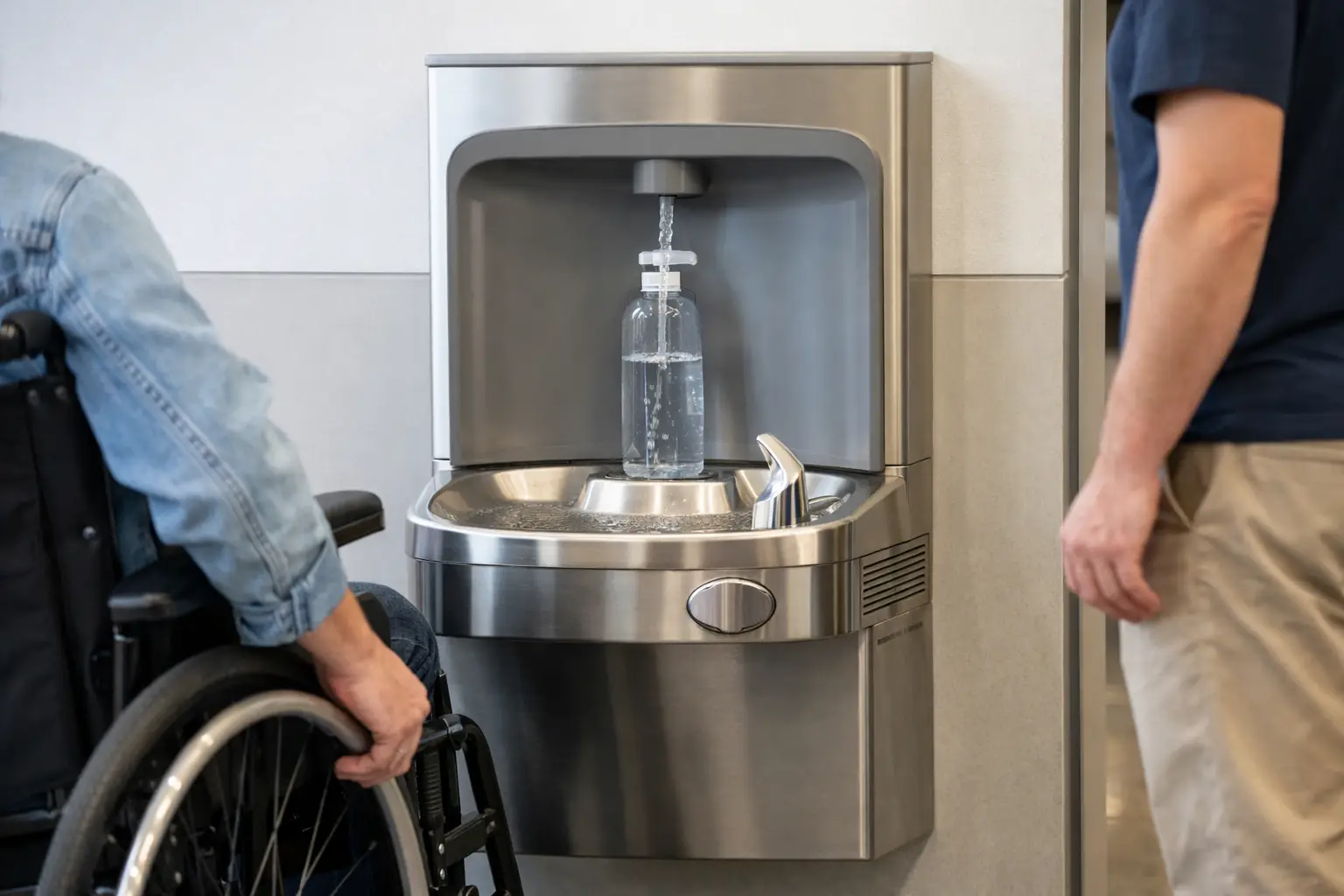
A bottle filler installed on a compliant drinking fountain can be a practical way to provide accessible drinking water while supporting reusable bottle use. It does not automatically make the complete station compliant. The fountain below it, the filler activation area, and the available approach must each work for the user intended to access them.
Accessible Drinking Fountain Heights
Where drinking fountains are required, accessibility scoping typically requires access for both wheelchair users and standing users. On many projects, this is accomplished with a bi-level or high-low fountain arrangement. The lower fountain serves a forward approach by a wheelchair user, while the higher fountain serves people who cannot comfortably bend to the lower spout height.
For the wheelchair-accessible drinking fountain, the spout outlet is generally limited to 36 inches maximum above the finished floor. The unit must also provide the knee and toe clearance needed for a forward approach. For the standing-person fountain, the spout outlet is generally required to be 38 to 43 inches above the finished floor.
A bottle filler mounted above the low fountain may sit much higher than the fountain spout. That can be acceptable only if its operable component and bottle placement area remain within the applicable reach limits and the overall installation meets the governing standard. Do not assume that the height of the lower basin establishes compliance for the filler above it.
Reach Range and Operable Parts
The activation control, sensor zone, push button, or other user-operated feature must be usable within ADA reach range requirements. With an unobstructed forward approach, the typical allowable reach range is 15 inches minimum to 48 inches maximum above the finished floor. A side reach can extend to 54 inches maximum where allowed, but it depends on the approach and whether an obstruction is present.
This is where wall-mounted bottle fillers require close review. A unit may have a sensor-operated design rather than a traditional button, yet the user still needs to position a bottle and activate the station without excessive reach, force, or dexterity. If the design includes a manual control, it must generally be operable with one hand and cannot require tight grasping, pinching, twisting of the wrist, or more than 5 pounds of force.
Use the manufacturer cut sheet to identify the control height, bottle opening location, required wall depth, and recommended mounting elevation. Then compare those dimensions with the planned approach condition. A product description that says “ADA compliant” is useful, but it is not a substitute for reviewing the installed configuration.
Clear Floor Space and Forward Approach
An accessible drinking fountain requires a clear floor space at least 30 inches by 48 inches. For a wheelchair-accessible fountain, that space is positioned for a forward approach and is coordinated with the knee and toe clearance below the unit. The clear space cannot be reduced by trash receptacles, janitor equipment, door swings, decorative planters, queue rails, or adjacent fixture projections.
This is a frequent field problem in schools, offices, recreation facilities, and public corridors. The fountain is installed correctly, then a recycling station or furniture layout consumes the approach area. The issue is not resolved by moving the obstruction temporarily for inspection. The accessible route and clear floor space must remain usable in normal operation.
When the bottle filling station is located in a recess or alcove, check more than the fixture dimensions. Confirm the required clear floor space, accessible route width, door maneuvering clearance, and protruding-object conditions. A properly selected unit can still fail if the surrounding architecture blocks a wheelchair approach.
Bottle Fillers Do Not Replace Required Fountain Access
A bottle filling feature is often an addition to, rather than a replacement for, required drinking fountains. The project documents and applicable code determine how many drinking fountains are required and how many must serve wheelchair users and standing persons. A bottle filler alone may not satisfy those scoping obligations.
This matters during value engineering. Replacing a high-low drinking fountain assembly with a single bottle filler may reduce equipment cost, but it can remove the accessible drinking fountain function the design requires. Conversely, a listed high-low bottle-filling station can simplify coordination where the manufacturer provides a complete assembly engineered for accessibility, refrigeration, drainage, and installation.
For alterations, existing conditions add another layer. The scope of work, path-of-travel obligations, technical infeasibility provisions, local enforcement policy, and facility type can affect what must be upgraded. Do not apply new-construction assumptions to an alteration without reviewing the drawings and code analysis.
Installation Details That Affect Inspection
Field coordination determines whether a compliant fixture remains compliant after installation. Verify finished-floor reference points before rough-in, especially where flooring build-up, ramps, or sloped surfaces change the final elevation. The installation instructions should match the selected model, not a similar model from the same manufacturer.
Pay particular attention to the wall backing and carrier requirements. Commercial fountain and bottle-filler assemblies can impose significant loading on the wall, particularly where users lean on the basin or use it for support. Inadequate backing can lead to movement, damaged finishes, and a failed installation even if the original mounting elevation was correct.
Also coordinate electrical service, refrigeration components, water supply, trap configuration, waste connection, filter access, and maintenance clearances. A filter compartment that cannot be serviced without blocking a public corridor or removing adjacent finishes creates an operating problem that the submittal should have exposed.
Protruding-object rules are another area to review. Equipment located along circulation paths can create a hazard for people with visual impairments when it projects beyond permitted limits. Recessed installations, compliant cane-detectable elements, or careful placement may be needed depending on the fixture depth and corridor layout.
Build a Better Submittal Package
For schedule-sensitive work, accessibility review should happen before procurement, not after the fixture is on site. A complete submittal package gives the design team and government reviewer the information needed to approve the exact station being purchased.
Include manufacturer cut sheets, installation instructions, dimensional drawings, rough-in requirements, electrical data where applicable, finish information, filter specifications, and any published accessibility statements. For a combined unit, show the heights of both fountain spouts as well as the bottle-filler control and dispensing area. If the project has a specified basis of design, identify substitutions clearly and document every dimensional difference.
Government and Milcon work may also require approved manufacturer information, domestic-preference documentation, cybersecurity or electronics-related review where applicable, and project-specific submittal forms. Those requirements are separate from ADA compliance, but a missing document can delay the same material release.
Specify the Complete Installation, Not Just the Fixture
The most reliable way to avoid rework is to put the accessibility check on the fixture schedule and the installation review. Confirm the applicable code edition, required drinking-fountain count, accessible user approach, mounting elevations from finished floor, clear floor space, and all operating controls before the purchase order is issued.
For a fast-moving project, Clarke Plumbing Specialties can help contractors and procurement teams assemble the product data and documentation needed to evaluate commercial bottle-filling equipment before it becomes a jobsite exception. The best time to solve a reach-range or fountain-height conflict is while the wall is still on paper, not when the inspector is standing in the corridor.