
A water heater that looks adequate on a fixture schedule can still leave a locker room, patient washroom, or employee shower area short at the worst possible time. To calculate hot water demand correctly, commercial teams need to size for real operating peaks, not simply count fixtures and select the next larger heater.
The result affects more than occupant comfort. An undersized system can create callbacks, disrupt operations, and trigger redesign work after equipment is already set. An oversized system can add unnecessary first cost, standby losses, electrical infrastructure requirements, and mechanical-room space. The right calculation connects the building’s use pattern, fixture demand, incoming water temperature, delivery temperature, recovery capability, storage volume, and distribution losses.
Start With the Building’s Actual Use
Fixture count is a starting point, not the answer. A school washroom, a correctional facility, a barracks shower building, a restaurant, and a manufacturing washdown area may have similar quantities of fixtures but entirely different hot-water profiles.
First identify who uses hot water, where they use it, and whether those events overlap. A modular housing manufacturer may see a predictable production-cycle demand. A health care facility may have continuous handwashing plus concentrated bathing demand. A public building may have short but sharp peaks around shift changes, meal periods, or event intermissions.
Review the plumbing plans alongside the owner’s operational information. For each hot-water zone, establish the fixture types, expected users, duration of use, and likely simultaneous operation. Separate loads when they are served by different heaters or where long piping runs make a central calculation impractical.
Published demand tables from applicable plumbing and engineering standards are useful for establishing diversity and probable peak flow. They are not a substitute for project-specific judgment. A standard table may be conservative for a lightly used office floor and inadequate for a facility with scheduled group showers. For government and institutional work, use the design criteria named in the contract documents and verify that the selected equipment aligns with required codes and agency standards.
Calculate Hot Water Demand at the Point of Use
The core calculation begins with mixed-water demand at each fixture or fixture group. A lavatory may deliver tempered water, while a service sink, commercial kitchen fixture, or shower may require a higher proportion of hot water. Demand schedules should distinguish between mixed outlet flow and actual hot-water flow.
Use the mixed-water equation to determine the hot-water portion:
`Hot-water flow = Mixed flow × (Mixed temperature – Cold temperature) ÷ (Hot supply temperature – Cold temperature)`
For example, assume a shower group requires 12 gpm of 105°F mixed water. If entering cold water is 45°F and stored hot water is 140°F, the hot-water portion is:
`12 × (105 – 45) ÷ (140 – 45) = 7.6 gpm of 140°F water`
That calculation matters because a 12 gpm mixed load is not the same as a 12 gpm hot-water load. It also shows why local groundwater temperature cannot be treated as a fixed national value. In colder climates and winter operating conditions, the required temperature rise increases and available mixed-water capacity decreases.
Use the cold-water design temperature required by the project or local design practice. Where seasonal temperature variation is substantial, size for the lowest credible entering-water temperature unless the contract documents direct otherwise. Record all assumptions in the calculation package. This makes submittal review and later field verification much easier.
Account for Thermostatic Mixing
Storage at 140°F or higher is common where storage capacity, sanitization practices, or code requirements support it. Distribution to public handwashing fixtures, showers, and other user points will often require tempering. That means the system must be assessed in two ways: stored hot-water capacity and usable mixed-water capacity at the delivery temperature.
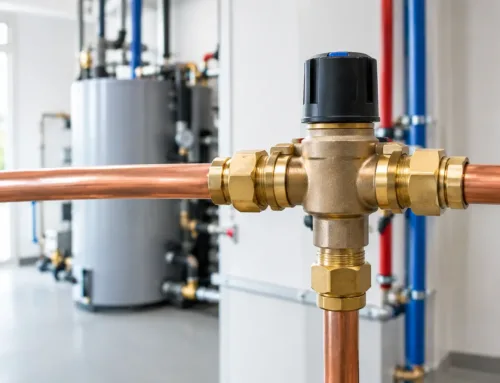
Do not assume a mixing valve automatically solves a capacity problem. It can stretch stored hot water by blending it with cold water, but it does not create recovery capacity. The valve must also be selected for the required flow range, pressure drop, minimum flow performance, and temperature-control requirements. In institutional applications, scald protection and the specified valve type are part of the system design, not an afterthought.
Convert Flow and Temperature Rise Into Recovery Load
Once the peak hot-water flow is known, calculate the heat required to sustain it. For water, the standard hourly heating-load formula is:
`BTU/hr = gpm × 500 × temperature rise`
The 500 factor is a practical approximation based on water weight and minutes per hour. Using the previous example, heating 7.6 gpm from 45°F to 140°F requires a 95°F rise:
`7.6 × 500 × 95 = 361,000 BTU/hr`
This is the approximate recovery load needed to continuously support that one peak condition. For electric resistance equipment, convert the result to kilowatts:
`kW = BTU/hr ÷ 3,412`
In this example, the continuous load is roughly 106 kW before considering equipment efficiency, piping losses, and any project-specific design margin. That number can materially affect feeder size, switchgear capacity, controls, and equipment lead time. Coordinate the heater selection with the electrical design team early rather than treating it as a late equipment substitution.
Gas-fired systems require a similar check of input capacity, recovery rate, venting, combustion air, gas piping, and available gas pressure. The heater’s published recovery rating must be evaluated at the project’s actual temperature rise. A catalog rating based on a different rise may not meet the job’s demand.
Balance Storage Against Recovery
Commercial water heating is rarely sized for continuous peak flow alone. Many loads occur in short bursts, and stored hot water can carry part of that peak while the heater recovers. The design question is how much of the demand is immediate drawdown and how much can be restored during and after the event.
High-storage, lower-recovery arrangements can work well for short, predictable peak events with sufficient recovery time between them. High-recovery, lower-storage equipment may suit a facility with extended or repeating demand. Neither approach is automatically better.
A locker room used by multiple teams in succession, for example, may need meaningful storage plus strong recovery. A handwashing-heavy facility may have lower individual draws but repeated demand throughout the day, making recovery and distribution performance especially important. A commercial kitchen can produce intermittent but substantial loads that must be reviewed by fixture, process, and operating schedule.
Manufacturer sizing tools and published selection tables can help narrow the equipment options, but they should be checked against the calculated profile. Confirm the stated storage volume, first-hour rating, recovery rate, input or kW, maximum working pressure, electrical characteristics, and physical dimensions. For replacement work, verify access routes, floor loading, clearances, seismic requirements where applicable, and the ability to remove the existing equipment without disrupting operations.
Include Distribution and Recirculation Losses
The heater is only one part of the hot-water system. Long distribution runs, poorly insulated piping, oversized recirculation pumps, and uncontrolled return temperatures can add load and reduce delivered performance.
Estimate heat loss from the supply and return piping based on pipe size, insulation, pipe length, ambient conditions, and operating temperature. Add that load to the heater’s recovery requirement where the recirculation system operates continuously or during occupied periods. A return-water temperature that is unexpectedly low may indicate excessive distribution loss, insufficient balancing, or a control issue rather than inadequate heater capacity.
Recirculation flow should be based on maintaining design temperature, not on the assumption that more pump flow is safer. Excessive flow can increase erosion risk, pump energy, noise, and heat loss. Balance valves, temperature controls, check valves, and properly commissioned pumps are central to consistent delivery in larger buildings.
Build a Calculation Package That Supports Procurement
A complete hot-water calculation should be easy for the engineer, owner, contractor, and equipment supplier to follow. Include the fixture schedule, assumed flow rates, diversity basis, cold-water temperature, storage temperature, delivery temperature, demand duration, recovery calculation, recirculation load, and selected equipment data.
For regulated projects, retain the manufacturer literature and certification documents required by the specifications. If equipment substitutions are considered, compare the complete operating performance, not only tank gallons or nameplate input. A lower-cost alternate can create approval delays or fail to match required recovery, controls, voltage, construction, or documentation.
Clarke Plumbing Specialties can support the equipment and documentation side of commercial and government project procurement, particularly when the specified heater, mixing components, fittings, or related materials need to stay aligned with an approved submittal package.
Before releasing equipment, pressure-test the assumptions against the building’s busiest operating hour. That one review often identifies whether the project needs more storage, more recovery, a separate zone, or better control of the demand already on the plans.