A water heater that is too small does not merely create a comfort complaint. In a restaurant, school, barracks, healthcare facility, or modular production line, it can interrupt operations, trigger failed performance expectations, and force an expensive correction after finishes are in place. To size commercial water heaters correctly, the project team must match real hot-water demand to the equipment’s usable storage, recovery capacity, heat source, and installation constraints.
The nameplate gallon capacity is only one part of the decision. A 100-gallon unit can perform very differently depending on its input rating, setpoint, incoming water temperature, draw profile, and the mixing valve strategy. Start with the building’s peak-use condition, then select equipment that can carry that load without oversizing the mechanical room or operating budget.
Start With the Actual Hot-Water Load
The first sizing question is not how many gallons the tank holds. It is when, where, and how quickly the facility needs hot water. A locker room has a concentrated shower demand. A commercial kitchen may have repeated dishwashing draws over several hours. A school restroom may see short, sharp handwashing peaks between class changes. These patterns call for different equipment even when the estimated daily gallons are similar.
Review fixture counts, fixture types, occupancy, operating schedules, and simultaneous use assumptions. The basis of design, plumbing schedule, equipment cut sheets, and local code requirements should all be part of the review. For government and institutional work, confirm that the demand assumptions align with the contract documents rather than relying on a generic rule of thumb.
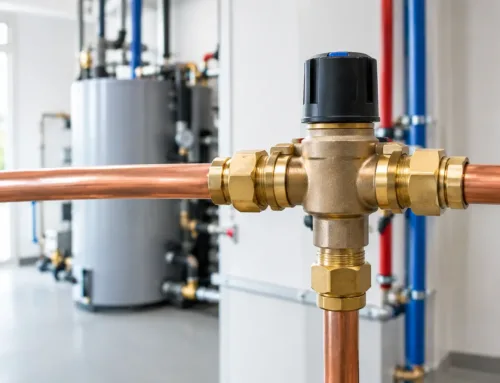
Hot-water demand should be measured at the fixture delivery temperature, not simply at the tank setpoint. Most commercial systems store water at a higher temperature and temper it down through a master mixing valve. That means stored hot water is blended with incoming cold water, increasing the effective usable volume. It also means the design must account for the mixing valve’s flow capacity and pressure-loss characteristics.
Calculate the Temperature Rise
Temperature rise is the difference between incoming cold-water temperature and the required storage temperature. It directly affects recovery capacity.
For example, if winter incoming water is 45°F and the heater stores water at 140°F, the unit must produce a 95°F temperature rise. If the system delivers 120°F water at fixtures through a mixing valve, the available 140°F stored water will be tempered with cold water. In colder climates, that same tank provides fewer delivered gallons than it would during warmer months.
Use the local winter design water temperature when sizing for dependable performance. A system sized around annual-average inlet temperature may appear adequate on paper and fall behind during the season when demand is hardest to meet.
Storage and Recovery Must Work Together
Commercial tank-type water heaters are sized around two connected capacities: storage and recovery. Storage handles the initial peak. Recovery replaces hot water as it is drawn down. Neither figure should be considered alone.
A high-storage, low-input system can handle a brief demand spike but may take too long to recover before the next peak. A high-input, low-storage system can recover quickly but may not provide enough immediate volume for a concentrated shower period, kitchen rush, or shift change. The right balance depends on the draw profile.
For gas-fired equipment, recovery is often expressed in gallons per hour at a stated temperature rise. The published rating must be read carefully. A heater rated for a given recovery at a 100°F rise will not produce the same number of gallons per hour at a 120°F rise.
For electric storage units, recovery is driven by element kW and available electrical service. A useful planning relationship is:
Recovery rate in gallons per hour = (kW × 3,412) ÷ (8.33 × temperature rise in °F)
This calculation helps establish whether the heater can recover between peak draws. Manufacturer performance data should still govern final selection, especially where multiple elements, staged controls, or approved operating limits apply.
Do not confuse first-hour rating with continuous recovery. The first-hour rating includes usable stored water plus recovery during the first hour of operation. It is valuable for many applications, but a facility with sustained demand needs a review of recovery over the entire operating period.
Size Commercial Water Heaters Around Peak Draws
Peak demand calculations should reflect simultaneous fixture use, not every fixture operating at once. A building with 40 lavatories rarely has all 40 running continuously. Conversely, a dormitory shower room or athletic facility can have a highly concentrated draw that broad fixture-unit calculations may understate.
For a practical review, map the major draw events across the day. Identify the duration of each event, required delivery temperature, expected flow rate, and the recovery time available before the next event. This approach is particularly useful for facilities teams evaluating replacement equipment, because actual operating experience can reveal demand patterns that original drawings did not capture.
Consider these common conditions:
- Food-service operations often require separate analysis for warewashing, prep sinks, hand sinks, and booster-heater loads.
- Multifamily, hospitality, and barracks projects need realistic occupancy and shower-use diversity assumptions.
- Schools and office buildings may have modest daily volume but significant short-duration restroom peaks.
- Manufacturing and modular facilities may need process hot water that should not be combined with domestic demand without a clear design basis.
Where the load is uncertain, build in measured capacity rather than simply selecting the largest available unit. Oversizing can increase first cost, standby loss, venting requirements, electrical service demand, and floor-space consumption. It can also create low-use operating conditions that are not ideal for the equipment or water-quality program.
Select the Right Equipment Configuration
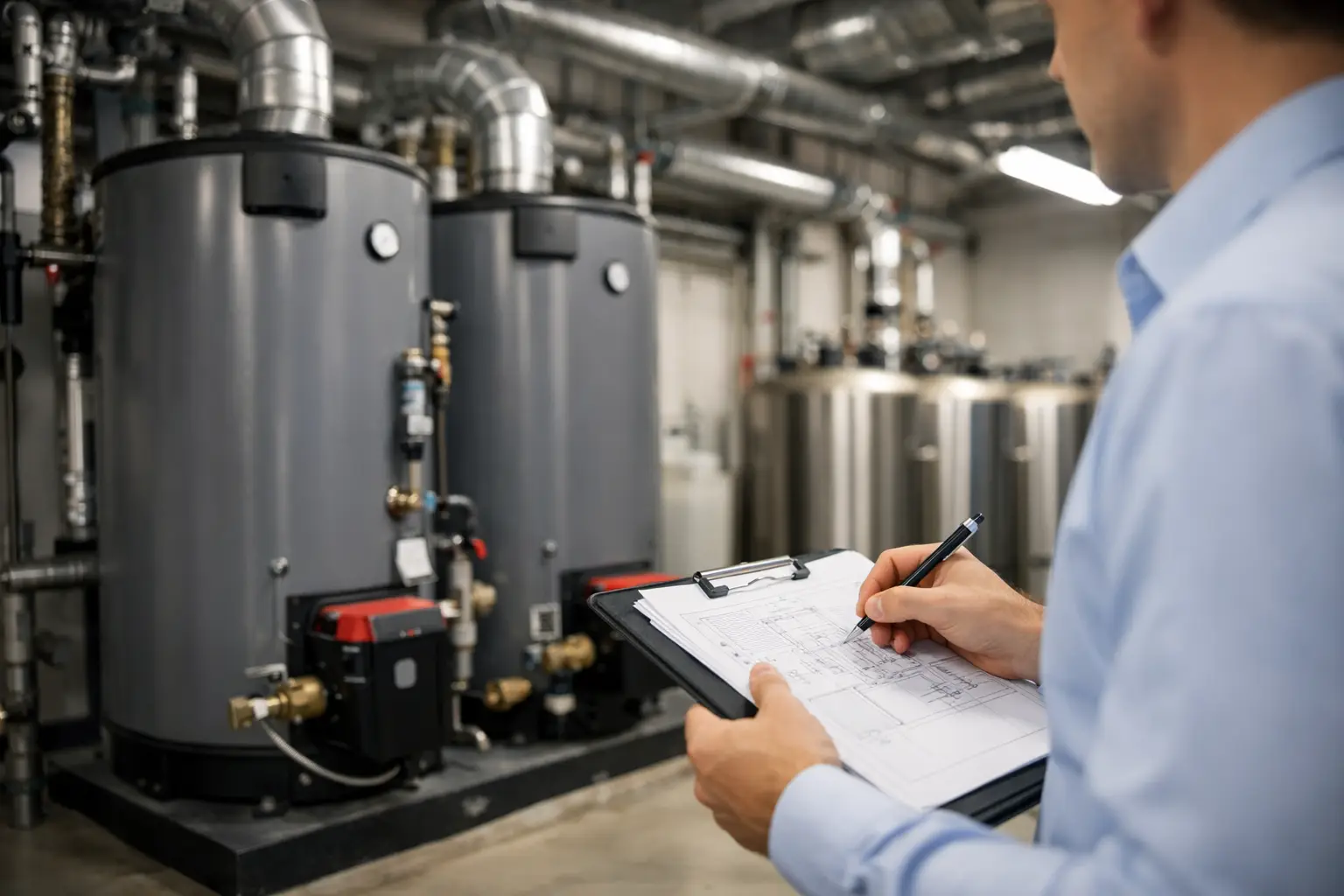
A single large storage heater is not always the best answer. Multiple units can provide staging, redundancy, easier handling, and better part-load operation. If one unit is down for service, a properly piped multi-unit system may still provide limited hot water instead of taking the facility completely offline.
However, multiple heaters require correct manifold sizing, balanced piping, isolation valves, check valves where required, and controls that rotate lead-lag operation. Poorly designed parallel piping can cause one heater to carry most of the load while the others sit underused.
Gas-fired storage heaters are often a practical choice where gas service, combustion air, venting, and floor space are available. High-input models can provide strong recovery in demanding applications, but vent category, condensate management, gas-piping capacity, and clearances must be coordinated early.
Electric storage heaters may suit projects where gas is unavailable, venting is difficult, or electrification is part of the design. Confirm voltage, phase, kW demand, breaker capacity, and panel availability before equipment is released. Electrical infrastructure can become the governing constraint, particularly when replacing gas equipment with electric units.
Instantaneous electric water heaters can be effective for remote lavatories, low-volume point-of-use applications, or situations where long recirculation runs are impractical. They are not a universal substitute for storage equipment. High-flow commercial applications can require substantial electrical capacity, and performance depends on inlet temperature, flow rate, and the unit’s maximum kW output.
Do Not Treat Distribution as a Separate Problem
A correctly sized heater can still deliver poor results if the distribution system is undersized or poorly controlled. Recirculation losses, long branch runs, excessive pipe heat loss, unbalanced return lines, and an undersized mixing valve all reduce available performance at the fixture.
Review the domestic hot-water return design with the heater selection. The recirculation pump, return piping, balancing valves, insulation, aquastat controls, and heater connection arrangement affect both energy use and recovery demand. Heat lost through the loop is a continuous load on the heater, not an afterthought.
For systems storing water above delivery temperature, select a master thermostatic mixing valve rated for the expected flow and temperature range. Provide point-of-use scald protection where required by code or the fixture application. The design must maintain safe delivery temperatures while meeting sanitation, infection-control, or process-temperature requirements.
Coordinate Code, Submittals, and Installation Details Early
Commercial water-heater sizing is a specification and procurement task as much as a mechanical calculation. Confirm the applicable plumbing code, energy code, authority having jurisdiction requirements, seismic restraints, expansion control, relief-valve discharge routing, drain-pan requirements, and combustion-air or venting provisions.
For public-sector and Milcon projects, the submittal package should clearly show capacity, recovery rating, input, electrical characteristics, efficiency, venting requirements, dimensions, weight, warranty, listed standards, and accessory compatibility. A mismatch between the approved heater and the specified mixing valve, vent system, stand, or expansion tank can delay release or field installation.
Before placing an order, verify the physical path from delivery point to mechanical room. Tank diameter, height, shipping weight, doorway clearance, roof access, and equipment-pad loading are routine issues until a replacement unit cannot reach the room. Confirm lead time for the heater and all required accessories at the same time. The project does not benefit from having a heater on site if the specified vent components or control valve are still unavailable.
A well-sized commercial water-heating system is built from verified demand, realistic winter conditions, compatible distribution components, and complete documentation. When the schedule is tight, Clarke Plumbing Specialties can help align the equipment, accessory requirements, and submittal details before a missing item becomes a jobsite delay.
The best final check is simple: walk through the facility’s busiest hour and ask whether the selected system can provide the required delivered temperature and flow, then recover in time for the next draw. If that answer is documented and the installation details are coordinated, the equipment selection is ready to support the project rather than become its next problem.