

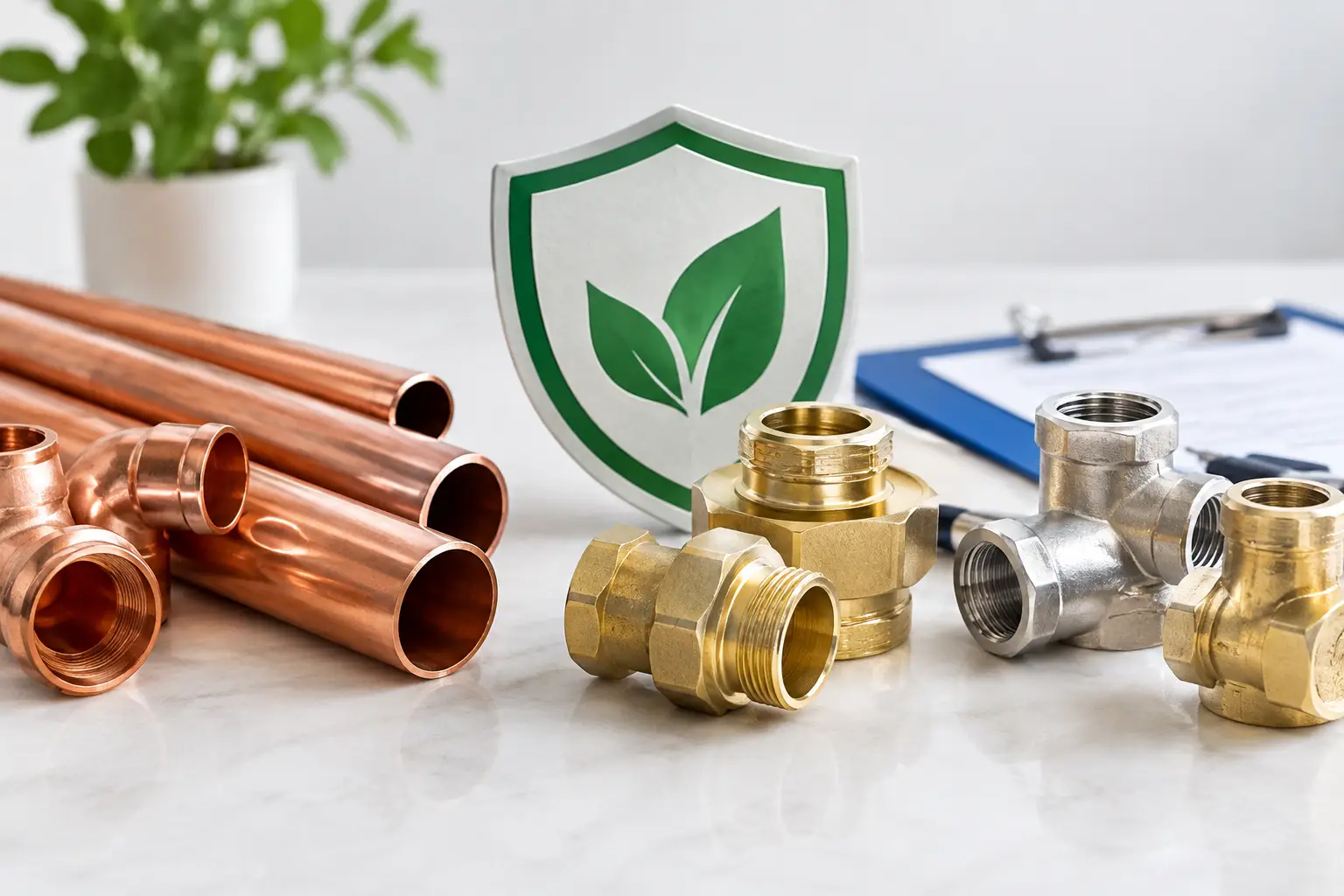
A product labeled “lead free” can still create a submittal problem if the certification, model number, and wetted-material application do not match the project requirement. For commercial contractors, manufacturers, facilities teams, and government buyers, lead free plumbing materials certification is not a box to check after purchase. It is part of how material gets approved, installed, inspected, and accepted without putting the schedule at risk.
The pressure is highest on drinking water scopes. A missing certificate or an unsupported substitution can hold up a fixture release, delay a rough-in inspection, or force a field replacement after labor has already been spent. The practical objective is simple: specify the right compliant item, retain the evidence that applies to that exact item, and prevent a supply change from breaking the approval package.
What Lead Free Certification Actually Confirms
For plumbing products used to convey or dispense potable water, federal law defines lead free based on a weighted average of no more than 0.25% lead across wetted surfaces. The standard applies to pipes, fittings, fixtures, solder, flux, valves, and other products that contact drinking water, subject to specific statutory exclusions.
That percentage is a material-composition requirement. A manufacturer statement saying that a product is made with lead-free brass may be useful, but it is not always the complete documentation a specification, authority having jurisdiction, or government reviewer expects. Third-party certification gives the project team a traceable basis for determining that a product meets the applicable lead-content requirement.
For many commercial plumbing products, NSF/ANSI/CAN 372 is the familiar standard used to verify lead-content compliance. Product listings, certification marks, and manufacturer documentation may reference that standard. Depending on the component and its use, NSF/ANSI/CAN 61 may also apply. The two should not be treated as interchangeable.
NSF/ANSI/CAN 372 addresses weighted average lead content. NSF/ANSI/CAN 61 evaluates potential health effects from contaminants that may leach from drinking-water-system components. A faucet, valve, water cooler, water heater, fitting, or specialty component may need one certification, the other, or both, based on the specification and intended application. The project documents control.
Where Lead Free Plumbing Materials Certification Matters Most
The question is not whether every item on a plumbing purchase order needs lead-free documentation. The question is whether the item contacts potable water and falls within the project’s code, specification, and procurement requirements.
Domestic water distribution is the most common area of concern. Copper tube, fittings, valves, backflow assemblies, strainers, mixing devices, faucets, drinking fountains, bottle-filling stations, electric water heaters, and related accessories can all trigger documentation review. The same applies to packaged systems and preassembled mechanical skids, where a single uncertified wetted component can affect acceptance of the complete assembly.
Products used solely for sanitary drainage, venting, storm drainage, or nonpotable process applications may not carry the same lead-free requirement. That does not mean they are exempt from all approvals. They still must meet the applicable material, performance, fire, corrosion, accessibility, or project-specific standards. The distinction matters because requesting the wrong certification wastes review time, while failing to request the needed one creates a preventable approval gap.
There are also gray areas. Reclaimed-water systems, laboratory systems, emergency fixtures, dual-purpose valves, and equipment installed near domestic-water piping require a close reading of the plans and specifications. If a component can serve potable water or is specifically identified in the submittal requirements, treat documentation as a procurement requirement before material is released.
Build Certification Into the Submittal Process
The strongest approach starts before an order is placed. If lead-free compliance is left for the closeout phase, the team may discover that the installed model is not listed, the certificate covers a different configuration, or the manufacturer has revised the product since the original submittal.
Start with the approved manufacturer and exact catalog number. Certification is often model-specific, size-specific, or configuration-specific. A valve family may include potable-water versions and industrial versions. A fixture can have optional components that change its compliance documentation. Never assume that a document covering a product line automatically covers every variation being supplied.
A usable documentation package typically includes four items:
- The manufacturer data sheet showing the exact product identification and intended application.
- A current third-party certification listing or certificate tied to the relevant standard.
- A clear compliance statement when the project requires confirmation of the federal lead-free definition.
- Any required country-of-origin, domestic-content, Buy American, or agency-approval documentation kept separate from lead-free records.
Keeping these records together improves review speed, but the documents should not be blended into one unsupported claim. Lead-free certification does not prove Buy American compliance. A domestic-content letter does not prove NSF/ANSI/CAN 372 certification. A product may satisfy one requirement and fail another. Government and Milcon work especially demands that each requirement be supported on its own terms.
Avoid the Substitution Trap
Material substitutions are often necessary. A specified valve, fixture, or fitting may have an extended lead time, a discontinued finish, an unavailable connection type, or a temporary factory allocation issue. A capable supply partner can source an alternate, but an alternate must be evaluated as a new compliance decision, not just a replacement part number.
Before proposing a substitute, compare the end connections, pressure and temperature ratings, flow characteristics, dimensions, accessibility requirements, warranty, finish, and certification status. For potable-water components, confirm that the alternate’s lead-free documentation applies to the exact model being offered. A visually similar item can have a different wetted material, trim package, or certification scope.
The timing of that review matters. Sending an alternate after the original item has been removed from the schedule leaves the contractor exposed. Sending the alternate with a clean comparison and current documentation gives the architect, engineer, owner, or government reviewer something they can act on. It also protects field crews from receiving material that cannot be installed once it reaches the jobsite.
For modular builders and OEM manufacturers, this discipline is equally valuable. Repeating a compliant bill of materials is more efficient than revalidating components on every production run. However, recurring purchasing is not a reason to stop checking. Manufacturers can change source factories, materials, component suppliers, or certification listings. Periodic verification is a practical control against a quiet product change becoming a production-line delay.
Common Documentation Failures That Cost Time
The most frequent issue is relying on a generic marketing statement rather than a certificate or listing. The second is submitting an outdated document without confirming that the current item remains covered. Another common failure is a mismatch between the model number on the purchase order and the model number in the submittal package.
A fourth problem is treating a certification logo on a cut sheet as complete proof. Logos can be legitimate, but reviewers may need the listing, scope, or certificate that connects the mark to the supplied configuration. This is particularly true when the product is a packaged assembly with multiple wetted components.
Finally, teams sometimes wait until inspection to assemble paperwork. By then, material may be installed behind walls, above ceilings, or incorporated into a manufactured unit. Documentation should travel with the procurement process: requested during quoting, checked before release, included with submittals, and retained for closeout when required.
A Practical Purchasing Standard
For schedule-sensitive work, assign ownership of compliance verification. The buyer should identify the requirement on the purchase order. The supplier should confirm available documentation for the offered model. The project manager or submittal coordinator should compare it against the specification. Field personnel should receive only approved material or clearly segregated pending material.
That process does not need to slow purchasing down. It prevents the more expensive kind of delay: expedited replacements, rejected inspections, remobilized labor, and disputes over who approved a noncompliant component. Clarke Plumbing Specialties supports this process by helping commercial and government buyers match available materials with the documentation their projects require.
When the next potable-water item is being quoted, ask for the applicable certification at the same time as price and availability. A compliant product that arrives with usable documentation is not just material delivered – it is material ready to move through approval and into the work.





Leave A Comment