A water-heating decision can affect much more than hot-water delivery. On a commercial project, electric vs gas water heaters can determine the size of utility work, mechanical-room layout, venting scope, electrical distribution requirements, inspection coordination, operating costs, and long-term service access. The right choice is the unit that meets the actual demand profile while fitting the building’s available infrastructure and approved project specifications.
For contractors, facility teams, modular manufacturers, and government-project buyers, the decision should start before a model number is selected. Confirm the load, available utilities, recovery requirements, physical constraints, code requirements, and documentation package. A unit that looks comparable on a schedule can create avoidable field changes if those details are not resolved early.
Electric vs Gas Water Heaters: The Core Difference
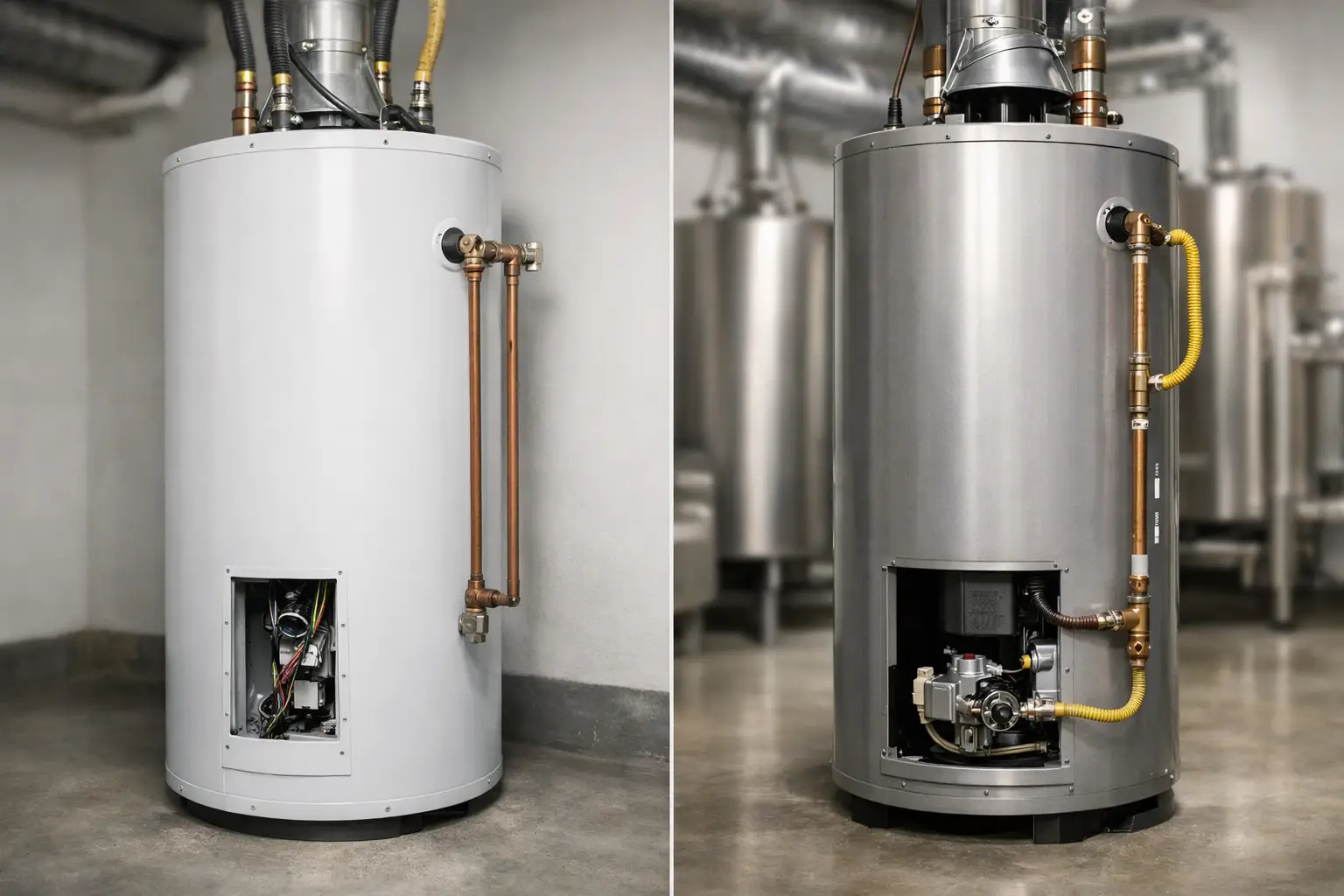
Conventional electric and gas storage water heaters both maintain a tank of heated water for use during peak demand. Their primary difference is the energy source and the infrastructure needed to support it. Electric units use resistance elements. Gas-fired units use a burner and require combustion air, venting, and a gas supply sized for the connected load.
Electric water heaters are often straightforward to locate because they do not need flue piping or combustion-air provisions. That can be a meaningful advantage in interior renovations, modular assemblies, occupied facilities, and areas where routing a vent to the exterior would be difficult. The trade-off is electrical demand. A commercial electric unit may require substantial amperage, dedicated overcurrent protection, and sufficient capacity at the panel or service.
Gas units generally offer higher input rates and faster recovery for a given tank size. They are common where a facility has an established natural-gas service and needs to support sustained demand from locker rooms, kitchens, laundries, healthcare functions, or high-use washroom groups. However, gas installation is not simply a matter of setting the heater and connecting a line. Vent category, vent material, combustion air, condensate handling on high-efficiency equipment, clearances, gas-pipe sizing, and roof or wall penetrations all affect the installed scope.
Size for Demand, Not Just Tank Volume
Tank capacity alone does not tell a purchaser whether a water heater will perform. The more useful question is how much hot water the building needs during its busiest draw period and how quickly the heater can recover afterward.
A facility with a short, intense demand window may need a larger stored volume, a higher recovery rate, or both. Consider a school locker room after practice, a shift-change shower bank in an industrial facility, or a commercial kitchen at meal service. A heater that works well during average use may run short during the hour that matters most.
For storage water heaters, review first-hour rating, recovery rate, input capacity, setpoint, and the design inlet-water temperature. Cold incoming water in many U.S. regions can materially reduce available hot-water performance during winter conditions. Recirculation also needs to be included in the calculation. Uninsulated or poorly controlled recirculation loops can impose a continuous load that changes equipment selection.
For applications with modest but continuous point-of-use demand, an instantaneous electric water heater may be a better fit than a central tank. These units are often useful at remote hand sinks, security buildings, small office additions, or locations where extending hot-water piping would introduce long wait times and unnecessary heat loss. They do require careful electrical coordination. A compact unit can still carry a significant electrical load, especially where a high temperature rise and higher flow rate are required.
When Electric Water Heaters Make Sense
Electric storage water heaters are a practical choice when electrical capacity is available and gas or venting infrastructure is limited, impractical, or prohibited by the project design. They can reduce mechanical complexity in locations where combustion equipment would require difficult routing or coordination with structural elements.
They are also well suited to installations where the building’s energy strategy favors electrification. Some public-sector and institutional projects are moving toward all-electric designs, while other facilities may have utility-rate structures that make electric operation acceptable. Those decisions should be confirmed with the owner and design team rather than assumed from a general market trend.
From a service standpoint, electric units eliminate burners, flues, and gas controls, but they are not maintenance-free. Elements can scale in hard-water areas, thermostats and contactors require service, and anode-rod inspection remains relevant for tank longevity. Procurement teams should verify voltage, phase, kilowatt rating, element configuration, connection size, relief-valve requirements, and any seismic or institutional specification requirements before release.
The limiting factor is frequently infrastructure. Adding a large electric water heater to an existing building can trigger service upgrades, panel changes, feeder work, or coordination with an electrical contractor. On a schedule-sensitive project, that upstream work can cost more time and money than the heater itself.
When Gas Water Heaters Are the Better Fit
Gas-fired water heaters are often the stronger option for high-demand central systems, particularly where natural gas is already present and the facility needs rapid recovery. Their ability to restore tank temperature quickly can allow a smaller footprint than an electric unit designed for the same sustained load, though the complete installation still needs room for venting, service access, and required clearances.
A gas unit can be especially effective in hospitality, food service, multifamily common facilities, manufacturing washdown areas, and institutional shower applications. Exact performance depends on the specified input, thermal efficiency, storage volume, and demand pattern. It should not be assumed that every gas unit will outperform every electric unit. A properly sized electric system can be more appropriate than an undersized gas system.
Gas equipment requires more coordination at submittal and installation. Verify fuel type, manifold pressure, input rating, venting method, vent termination requirements, condensate provisions, combustion-air approach, and compatibility with the building’s gas-piping design. High-efficiency condensing units may reduce fuel use but can add requirements for condensate neutralization, drain routing, and approved vent materials.
For replacement projects, field verification is essential. Existing venting may not be suitable for a new appliance, even when the tank capacity appears similar. Changes in efficiency category, input rating, or vent configuration can change the installation requirements and create an inspection issue if they are discovered after material arrives.
Installation Scope Often Decides the Comparison
The purchase price of the heater is only one line item. A useful comparison includes the full installed scope: electrical feeders and disconnects; gas piping and regulators; venting and roof penetrations; condensate piping; recirculation connections; floor drains or drain pans; seismic restraint; equipment pads; control integration; and access for future replacement.
Physical access deserves early attention as well. Commercial tanks can be difficult to move through finished corridors, tight mechanical rooms, rooftop access paths, or modular production lines. Confirm dimensions, shipping weight, connection locations, service clearances, and rigging conditions before ordering. A correct model that cannot be placed without opening a wall or changing a route is not a correct procurement decision.
For government and Milcon work, the documentation path is just as important. Match manufacturer data, electrical characteristics, fuel requirements, efficiency information, warranty language, certifications, and required accessories to the approved submittal. A substitution may be technically capable but still unacceptable if it does not satisfy the specified basis of design, approval process, or project documentation requirements.
Operating Cost Requires a Local Calculation
Gas is not automatically less expensive, and electric is not automatically the higher-cost option. Utility rates, demand charges, equipment efficiency, annual run hours, recirculation losses, maintenance practices, and local climate all influence the operating result.
Compare annual energy use using the project’s expected demand and local utility pricing. For electric equipment, include the possible effect of added peak electrical demand. For gas equipment, include fuel charges as well as venting, combustion, and maintenance considerations. Facilities with solar generation, time-of-use electric rates, or specific decarbonization targets may reach a different answer than facilities focused on existing gas infrastructure and rapid recovery.
The most reliable approach is to evaluate first cost, installed cost, operating cost, expected maintenance, and replacement complexity together. This prevents an apparent equipment savings from becoming a larger change order or facility burden later.
A Procurement Checklist Before Release
Before placing an order, confirm the scheduled equipment is matched to the field conditions and approved documents. The release should account for capacity and recovery, voltage or fuel type, connection sizes, venting method, physical dimensions, accessories, control requirements, warranty, and lead time. If the unit serves a recirculation system, confirm pump and control compatibility rather than treating the heater as an isolated component.
Also confirm whether the project requires a specific manufacturer, domestic content documentation, third-party listings, efficiency compliance, seismic accessories, or special submittal forms. These items are easier to resolve before a purchase order than after equipment has been delivered to an active jobsite.
The best choice between electric and gas is the one that protects the project schedule while delivering the required hot-water performance. Start with the building load and infrastructure, then make sure the selected equipment, accessories, and documentation arrive ready for installation and approval.