A water-heater decision can affect far more than utility consumption. On a commercial job, the choice between tank vs tankless water heaters affects electrical load calculations, mechanical-room space, fixture recovery expectations, maintenance access, equipment lead times, and the documentation needed to move a submittal through approval.
For contractors, facility teams, and procurement professionals, neither option is automatically better. The correct selection comes down to the building’s hot-water profile, available utilities, peak demand, redundancy requirements, and the owner’s service expectations after turnover.
Tank vs Tankless Water Heaters: The Working Difference
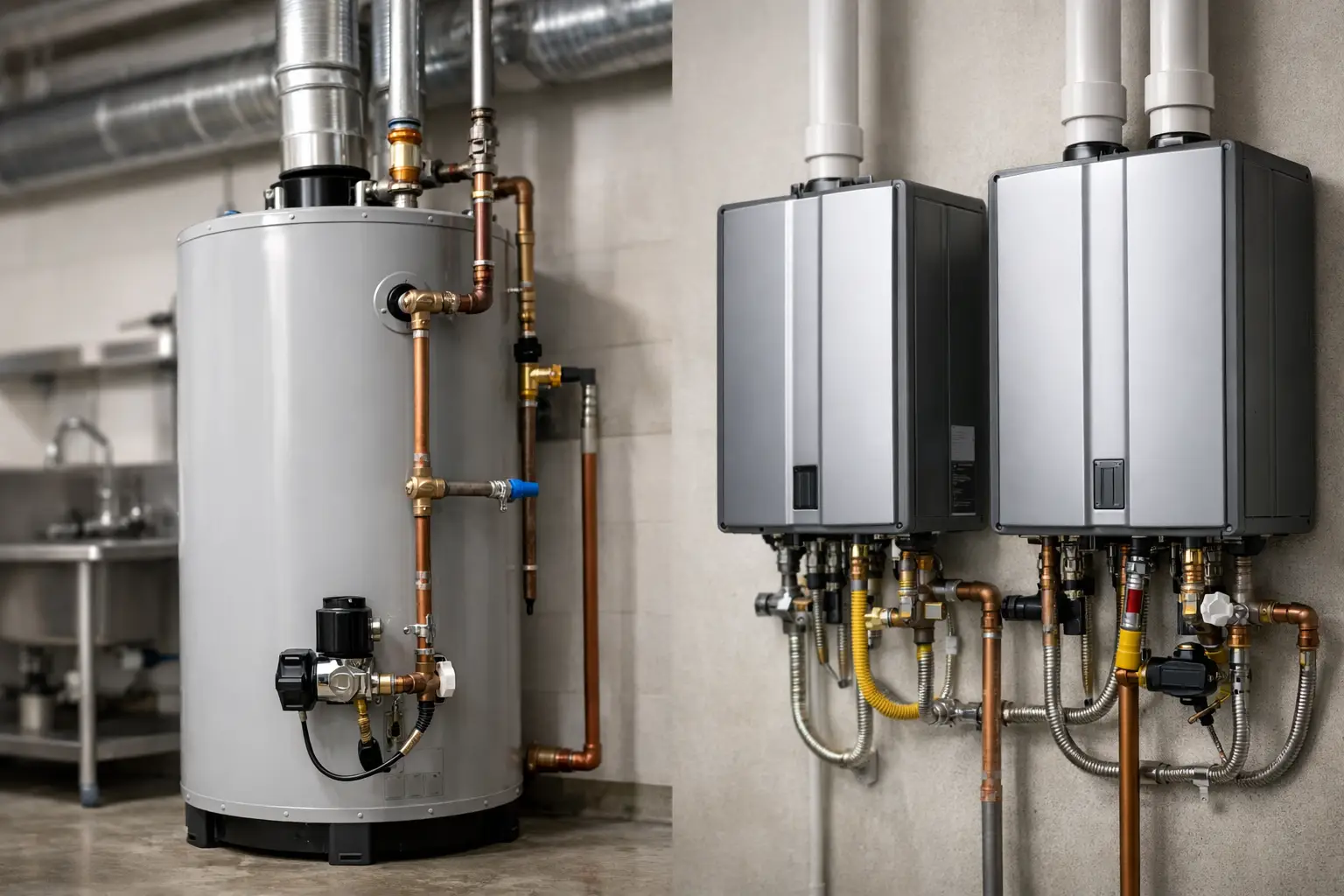
A conventional storage water heater heats and stores a predetermined volume of water in a tank. When a fixture calls for hot water, the system delivers water from that stored supply while the heater works to recover the tank temperature. Storage systems may be electric, gas-fired, heat-pump based, or connected to a central boiler plant, depending on the application.
A tankless unit heats water only when there is a demand. As cold water moves through the unit, electric elements or a gas burner raise the temperature to the setpoint. There is no stored reserve inside the appliance, so available hot water depends on the unit’s heating capacity and the incoming-water temperature.
That distinction is straightforward. The specification work is not. A storage system must be evaluated for gallon capacity and recovery rate. A tankless system must be evaluated for the required temperature rise at the actual peak flow rate. Specifying a tankless heater based on a nominal gallons-per-minute rating without accounting for winter inlet water temperatures can create a performance problem that does not become visible until commissioning or occupancy.
When a Storage Tank Is the Better Fit
Conventional tank water heaters remain a practical choice for many commercial and institutional applications, particularly where usage comes in short, high-demand periods. Locker rooms, employee shower areas, kitchens, dormitory facilities, and certain healthcare support spaces can place several simultaneous draws on a system. A properly sized storage tank provides a buffer during those peaks.
The key advantage is stored capacity. A tank can meet a sharp demand surge even when the heat source cannot instantly match the flow rate. The recovery rate then determines how quickly the equipment restores that stored volume for the next demand cycle. For buildings with predictable morning, lunch-period, or shift-change usage, this can be easier to size and explain to the owner.
Storage equipment may also be the more workable choice when an existing electrical service has limited spare capacity. Large electric tankless heaters can require substantial amperage, often driving feeder, panelboard, disconnect, and transformer upgrades. A storage-type electric heater typically spreads its heating load over a longer period, although its actual electrical requirements still need to be coordinated with the engineer and electrical contractor.
There are trade-offs. Tanks occupy more floor area, need clearance for service and replacement, and have standby losses as stored water is maintained at temperature. Their service life can also be affected by water quality, anode condition, sediment accumulation, and neglected temperature and pressure relief components. On a facility replacement project, verify the access path as carefully as the equipment footprint. A unit that fits the mechanical room on paper may not fit through corridors, doors, or rooftop access points.
Storage systems work well when demand is concentrated
A tank is often a strong fit when the project needs immediate capacity at a known peak, has room for the equipment, and can support scheduled maintenance. It can also simplify replacement work where the existing piping, venting, electrical infrastructure, and controls were designed around a storage system.
For public-sector and regulated projects, the selected model must still satisfy the schedule, specified efficiency requirements, seismic provisions where applicable, insulation standards, and all requested product documentation. Substituting based only on tank volume or input rating is risky when the bid package identifies a specific approved basis of design.
Where Tankless Water Heaters Make Sense
Tankless water heaters are particularly useful where demand is intermittent, point-of-use, or limited to a small number of fixtures. Lavatory groups, guard stations, break rooms, remote restroom additions, maintenance closets, and certain modular applications can be good candidates. The compact footprint can free up valuable wall or floor space, and a point-of-use arrangement can reduce long hot-water runs and the water wasted while occupants wait for temperature.
Instantaneous electric water heaters are common in commercial settings because they avoid combustion venting and can be installed near the fixture group they serve. They are not a universal replacement for a central domestic hot-water system. Their capacity is directly tied to available electrical infrastructure and the design flow rate.
For example, a small handwashing load may be handled efficiently by a point-of-use unit. Multiple showers, commercial sinks, or several high-flow fixtures operating at once may require a much larger unit or a staged bank of heaters. If electrical capacity cannot support the calculated demand, the equipment selection will not solve the problem by itself.
Tankless equipment can reduce standby energy use because it does not maintain a large stored volume. That advantage is most meaningful where draws are infrequent. In a facility with nearly continuous hot-water demand, actual operating savings depend on equipment efficiency, control settings, distribution losses, recirculation requirements, demand diversity, and local utility costs. Energy claims should be reviewed against the building’s real use pattern, not a residential comparison.
Tankless systems require careful flow and temperature calculations
The most common tankless specification error is underestimating the required temperature rise. A unit may appear adequate at a modest inlet-water temperature but produce less usable flow when incoming water is colder. The design team should establish the coldest anticipated inlet temperature, required delivery temperature, fixture flow rates, simultaneous-use assumptions, and any mixing-valve strategy before finalizing capacity.
For electric units, confirm voltage, phase, kilowatt rating, wire size, overcurrent protection, disconnect requirements, and available fault current coordination. For gas-fired tankless equipment, confirm fuel capacity, venting category, combustion-air requirements, condensate handling where required, and manufacturer clearances. These are not field adjustments to leave until equipment arrives.
Space, Distribution, and Maintenance Planning
Mechanical-room space is only one part of the comparison. A central storage system may take more room at the heater but can serve a broad distribution network. Point-of-use tankless units may reduce distribution distance, but they can increase the number of equipment locations that facilities staff must inspect and maintain.
Hard water deserves attention in either approach. Scale reduces heat transfer and can shorten component life. Tankless heat exchangers may require periodic flushing, while tanks can accumulate sediment and need anode and relief-valve inspections. A facility with known water-quality issues should include treatment, flushing connections, isolation valves, and realistic maintenance procedures in the design rather than treating them as optional accessories.
Redundancy also changes the decision. One large storage heater may be adequate for a low-risk application, but a critical facility may require multiple heaters, staged tankless units, or a duplex arrangement so a single failure does not interrupt service. The equipment schedule should identify the intended operating sequence and what level of hot-water service remains available during maintenance or failure.
Procurement Details That Prevent Delays
Water-heater procurement is more than selecting a capacity. Commercial buyers should verify the exact model number, voltage or fuel configuration, element or burner input, connection sizes, mounting method, control options, warranty terms, and accessory requirements. Relief valves, expansion tanks, mixing valves, unions, isolation valves, drain pans, stands, seismic restraints, vent components, and electrical disconnects may all be necessary to complete the installation.
For government and Milcon work, the documentation path can be as important as the equipment itself. Confirm required submittal data, compliance statements, cut sheets, installation instructions, certifications, country-of-origin requirements when applicable, and approved-equal procedures before placing material. An item that meets the functional need but lacks required documentation can delay approval just as effectively as an incorrect model.
Lead time should be reviewed early, especially for uncommon voltages, high-kilowatt instantaneous units, large-capacity commercial tanks, and specified manufacturers. If an approved alternative is needed, start that process while there is still time to protect the schedule. A replacement decision made after rough-in can force changes to electrical, piping, venting, or mounting conditions.
Make the Selection Around the Actual Load
Choose a storage water heater when the project needs a reserve for concentrated demand, has space for the equipment, and can support routine tank maintenance. Choose tankless equipment when the demand is intermittent or localized, distribution runs can be reduced, and the electrical or gas infrastructure can support the required temperature rise and flow.
Before releasing the order, match the equipment to the fixture schedule, utility capacity, installation conditions, and approval requirements. That coordination is what keeps a water-heater selection from becoming a late-stage field problem.