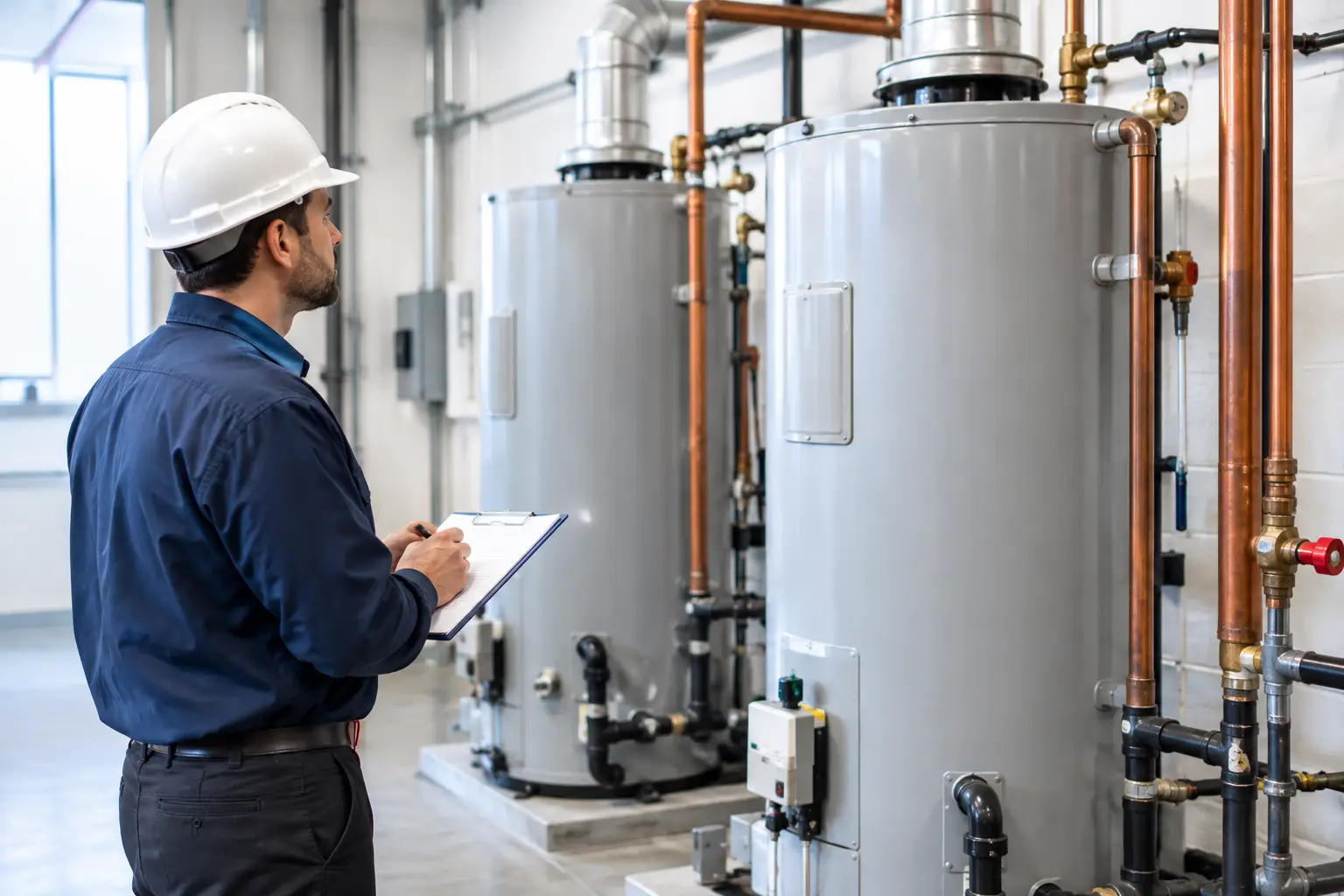
A water heater rarely fails at a convenient time. In a school, barracks, hotel, manufacturing plant, modular assembly line, or public facility, a failed unit can stop sanitation operations, delay occupancy, create emergency labor costs, and put an inspection or turnover date at risk. Understanding water heater lifespan helps project teams plan replacement around operations instead of reacting to a shutdown.
For commercial buyers, the useful question is not simply, “How many years will this unit last?” Service life depends on equipment type, demand profile, incoming water conditions, installation quality, maintenance discipline, and whether the original unit was correctly sized. A published warranty can establish a baseline, but it is not a replacement schedule.
Typical Water Heater Lifespan by Equipment Type
Conventional tank-type commercial water heaters commonly provide about 8 to 15 years of service. Units with favorable water conditions, proper sizing, routine flushing, and an active anode rod program may operate beyond that range. High-demand applications, hard water, continuous recirculation, or poor maintenance can shorten it substantially.
Tankless and instantaneous water heaters have a different service profile. A well-maintained tankless gas unit may remain in service for 15 to 20 years, while commercial instantaneous electric water heaters can also provide long service when their elements, controls, and electrical components are properly matched to the application. Unlike a storage tank, these products do not have a large vessel holding heated water that can corrode from the inside. That does not make them maintenance-free. Scale, failed heating elements, control issues, and inadequate electrical capacity can still take a unit offline.
For facilities with multiple point-of-use heaters, the replacement decision is often less about age alone and more about standardization. Replacing several aging, mismatched units with properly specified equipment can simplify parts stocking, service training, and future purchasing.
What Shortens a Water Heater’s Service Life
Water chemistry is one of the strongest predictors of water heater condition. Hard water leaves mineral scale on tank bottoms, heat exchangers, and heating elements. That scale reduces heat transfer, increases recovery time, drives up energy use, and can cause localized overheating. Sediment also occupies tank volume, leaving less usable hot water during peak demand.
Corrosion is the other major threat, particularly in storage equipment. Tank linings, connections, and fittings are exposed to constant heat and water. The sacrificial anode rod is designed to corrode before the tank itself does. Once that protection is depleted, internal tank deterioration can accelerate. A leaking tank is generally a replacement event, not a repair opportunity.
Sizing errors create a quieter but equally costly problem. An undersized heater works at or near maximum capacity through repeated peak periods. In a commercial restroom group, kitchen support area, locker room, or modular production process, that can mean excessive cycling, poor temperature recovery, and premature component wear. Oversizing carries its own trade-off: unnecessary first cost, standby loss, larger space requirements, and equipment that may not operate efficiently at the actual load.
Installation details matter as well. Improper venting on gas-fired equipment, incorrect pressure settings, missing expansion control, poor dielectric isolation, inadequate combustion air, or unsupported piping can reduce reliability and create code issues. On electric units, undersized conductors, improper disconnecting means, or insufficient available electrical capacity can result in nuisance failures and difficult commissioning.
The Operating Conditions That Change the Answer
A commercial water heater in a lightly used administrative building has little in common with a unit serving continuous handwashing, food service, patient care, or shift-based industrial use. Duty cycle changes everything.
Facilities teams should consider peak demand, not just average daily consumption. A system that appears adequate based on total gallons per day may still fail to meet demand when dozens of fixtures operate during a short break period. Recovery rate, storage volume, temperature rise, fixture flow rates, and recirculation losses all need to be considered together.
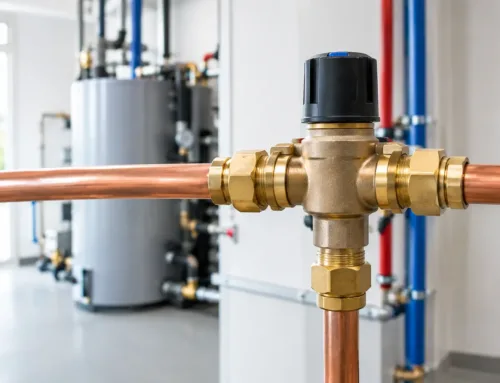
Temperature settings also affect water heater lifespan. Higher stored-water temperatures can support capacity and help manage certain hygiene requirements, but they place additional stress on equipment and increase scale formation potential. Mixing valves may be required to deliver safe fixture temperatures while the system stores water at a higher temperature. The correct approach depends on building use, code requirements, engineer-of-record specifications, and facility operating standards.
For government and institutional projects, replacement planning should also account for approved equals, required submittals, domestic-content provisions where applicable, lead times, and documentation requirements. The best replacement product is not helpful if it cannot be approved, delivered, and installed within the available outage window.
Maintenance That Protects the Investment
Maintenance cannot reverse a deteriorated tank, but it can identify manageable problems before they become an emergency. The right interval depends on water quality and usage, though heavily used or hard-water applications need closer attention than low-demand locations.
A practical maintenance program should include these distinct checks:
- Inspect the tank, piping connections, valves, venting, electrical connections, and floor area for leaks, corrosion, staining, or unsafe conditions.
- Flush sediment from storage tanks as permitted by the manufacturer and assess the amount and character of material removed.
- Check anode rod condition on applicable tank-type units and replace it before the tank loses corrosion protection.
- Verify operating temperature, recovery performance, pressure relief valve condition, controls, thermostats, heating elements, burners, and combustion performance as applicable.
- Review recirculation operation, balancing, insulation, and return-water temperatures to identify unnecessary heat loss or excessive runtime.
Documentation matters as much as the service work itself. Record serial numbers, installation dates, maintenance findings, recurring repair parts, water-quality observations, and performance complaints. A maintenance log gives facilities teams a factual basis for capital planning. It also helps a contractor or supplier identify the correct replacement configuration when time is limited.
Repair or Replace: Make the Decision Before Failure
A heater does not need to be actively leaking to justify replacement. Frequent service calls, declining recovery, escalating energy use, unavailable parts, or a unit approaching the upper end of its expected service range can all support a planned replacement.
Repairs make sense when the issue is isolated and the vessel remains sound. A failed element, thermostat, igniter, sensor, circulator-related issue, or relief valve can often be corrected economically. The decision becomes less favorable when a tank shows external corrosion, internal leakage, repeated burner or control failures, or significant scale-related performance loss.
For a scheduled replacement, start with field verification. Confirm fuel type or electrical characteristics, voltage and phase, physical dimensions, venting arrangement, connection sizes, recovery requirements, seismic or restraint requirements, existing controls, and access path. A replacement that looks equivalent on a cut sheet may not fit the mechanical room, clear a doorway, or meet the facility’s actual peak load.
This is also the right time to consider whether the existing equipment arrangement still serves the building. A single large storage unit may be appropriate for one facility, while a staged bank of heaters can offer redundancy and easier service for another. Point-of-use electric water heaters can reduce long recirculation runs in remote fixture groups, but they require adequate electrical infrastructure and careful demand calculations.
Build Replacement Into the Procurement Plan
Waiting for a failed water heater turns a technical purchase into an availability problem. The specification may call for a particular manufacturer, capacity, voltage, vent category, or control package. Government and Milcon work may add approval and submittal requirements. If those details are not captured early, the job can lose days to clarification and resubmittal while the facility remains without reliable hot water.
Review the equipment inventory annually, flag units by age and condition, and identify assets that are approaching a planned replacement window. For critical facilities, confirm acceptable replacement options before an outage occurs. Keep model information, approved submittals, and field dimensions available to the people responsible for purchasing and maintenance.
Clarke Plumbing Specialties supports commercial buyers who need more than a catalog number. When a heater replacement affects a shutdown, production schedule, inspection, or government-project requirement, accurate product identification and complete documentation help keep the material side of the job moving.
The most useful replacement plan is the one built while the existing heater is still operating. It gives your team time to verify capacity, secure approvals, coordinate labor, and select equipment that will serve the facility for its next operating cycle.