
A water heater can look correct on a plumbing schedule and still create a field problem. The usual failure points are not the tank or heating elements themselves. They are peak-demand assumptions, available electrical capacity, recovery calculations, mounting constraints, control requirements, and missing submittal details. To specify electric water heaters effectively, the equipment selection has to match how the building will actually use hot water and how the project will install, inspect, and maintain it.
For commercial contractors, facility teams, modular manufacturers, and government buyers, this is a coordination task as much as a plumbing task. The right unit must satisfy the fixture load, electrical drawings, code requirements, owner standards, and procurement documentation without introducing a late-stage exception.
Start With the Actual Hot-Water Load
Begin at the point of use, not with a familiar model number. A breakroom sink, janitor closet, lab handwash station, dormitory shower bank, and commercial restroom all create different demand profiles. Two locations may have the same total daily water use but require very different heater capacities because one has frequent short draws while the other has several high-flow draws at the same time.
For storage-type electric units, determine the required first-hour rating and recovery rate. First-hour rating addresses the usable hot water available during the initial peak period. Recovery rate shows how much water the unit can heat after stored volume is depleted. A large tank with insufficient input can leave a facility waiting for recovery. A high-input unit with excess storage may consume space, electrical capacity, and budget without adding meaningful performance.
For instantaneous units, establish required flow rate at the design incoming-water temperature and required outlet temperature. This is where specifications often become optimistic. Electric tankless capacity falls as the temperature rise increases. A unit that supports a lavatory in a temperate region may not produce the same result during winter conditions or at a location with colder incoming water.
Consider diversity realistically. A school restroom, manufacturing wash station, or barracks facility may see highly concentrated demand. A remote service sink may not. Avoid applying the same diversity factor across every space simply because it simplifies the schedule.
Choose Storage or Instantaneous Equipment for the Application
Electric storage water heaters remain a practical choice where several fixtures need dependable capacity, where demand occurs in clusters, or where electrical service cannot support large instantaneous loads. They are generally straightforward to service and can provide a buffer during busy periods. Their trade-off is floor area or wall space, standby energy use, and the need to account for recovery time.
Instantaneous electric water heaters are often well suited to remote lavatories, handwashing stations, guard shacks, modular units, small offices, and point-of-use applications. They can reduce distribution losses by putting heat close to the fixture and eliminate the storage tank. They also require careful electrical coordination. High-kW models may need substantial feeder capacity, multiple breakers, and wiring that is not available at the intended installation point.
A mixed strategy is often the most effective solution. A central storage heater can serve the main fixture group, while point-of-use instantaneous units address isolated fixtures with long piping runs. That approach can improve response time without oversizing the central system solely to compensate for heat loss in distribution piping.
Account for Temperature Setpoint and Mixing
Required delivery temperature is not necessarily the same as tank setpoint. Where the system stores water at a higher temperature for capacity or hygiene reasons, a listed thermostatic mixing valve may be needed to limit distribution temperature. The specification should state the intended storage temperature, mixed outlet temperature, valve capacity, and any recirculation arrangement.
Do not treat the mixing valve as an accessory to be figured out later. Its flow capacity, pressure drop, checks, balancing requirements, and service access affect system performance. For projects with accessible fixtures or public use areas, stable delivery temperature is part of both safety and owner expectations.
Coordinate Electrical Requirements Before Release
Electric water heaters are frequently delayed because the plumbing selection reaches the electrical team after panel schedules are already tight. Confirm voltage, phase, kW input, amp draw, overcurrent protection, disconnect requirements, conductor sizing, and available panel capacity before finalizing the equipment.
Commercial electric heaters are commonly available in several voltage and phase configurations. A model family may look identical while carrying materially different electrical requirements. Specify the exact configuration rather than relying on a broad description such as “electric water heater, 208/240 V.” The approved unit should align with the project’s actual service voltage, not a voltage range that requires field interpretation.
For instantaneous equipment, request the manufacturer’s electrical data for the selected flow and temperature-rise condition. Nameplate kW is only one part of the decision. Installation may require multiple dedicated circuits or a panel upgrade. On modular and factory-built assemblies, electrical routing and access to disconnects must also be coordinated before the unit is enclosed.
Write a Specification That Can Be Purchased and Installed
A usable specification does more than identify gallons, kW, and manufacturer. It gives the procurement and field teams enough information to obtain a compliant unit without guessing at what was intended. The equipment schedule should identify capacity, recovery or flow performance, voltage, phase, kW input, maximum working pressure, tank construction or heat-exchanger materials, insulation, controls, safety devices, mounting orientation, and required accessories.
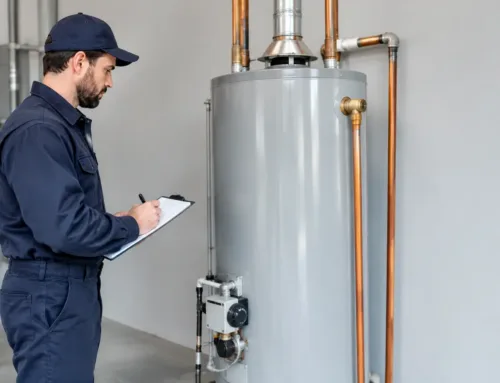
For storage water heaters, specify whether the unit is floor-mounted, wall-mounted, or installed on a stand. Confirm service clearances for element replacement, thermostat access, drain valves, relief-valve discharge piping, and anode inspection where applicable. A heater that fits in plan view may still be impractical to maintain once piping, framing, and adjacent equipment are installed.
For instantaneous units, identify the fixture or fixture group served and whether the unit is intended to provide a fixed outlet temperature, a temperature rise, or a thermostatically controlled delivery temperature. Include required integral or external controls, pressure-loss limits, minimum activation flow, and whether the unit must operate with low-flow metering fixtures.
Accessories should be explicit where required. Depending on the system, that may include a temperature and pressure relief valve, drain pan, seismic restraints, expansion tank, vacuum relief, isolation valves, dielectric connections, mixing valve, recirculation connections, mounting bracket, or stand. Leaving these items vague can create scope gaps between plumbing, mechanical, electrical, and general trades.
Verify Codes, Listings, and Project Standards
The applicable code path depends on the jurisdiction, building occupancy, plumbing code, electrical code, energy code, and owner requirements. Public-sector work may add agency criteria, approved-product requirements, domestic-content provisions, cybersecurity requirements for connected controls, or specific submittal formats. Milcon and federal projects often demand disciplined documentation before material can be released.
At a minimum, confirm that the selected equipment carries the listings required for the project and that its pressure, temperature, and electrical ratings suit the installation. Check energy-efficiency requirements, insulation provisions, accessibility implications, and relief-valve discharge routing. Where a water heater serves a special occupancy such as health care, food service, correctional, educational, or laboratory space, verify the owner’s operational standards early.
Submittals should include product data, dimensional information, performance data, electrical characteristics, installation requirements, and accessory details. If the project requires a basis-of-design product but allows substitutions, compare the proposed unit line by line. “Equal” should mean equal in capacity, recovery, electrical demand, controls, physical dimensions, warranty requirements, and serviceability, not simply similar tank volume.
Plan for Lead Time and Field Reality
Approved equipment is only useful if it arrives when rough-in, modular assembly, or final trim needs it. Specialty voltages, high-kW instantaneous units, corrosion-resistant tanks, unusual orientations, and project-specific accessory packages may not carry the same availability as standard commercial models. Confirm availability before a selection becomes a schedule commitment.
This is especially relevant when water heaters are part of repeatable manufacturing or phased construction. Standardizing on a vetted configuration can reduce approval time and prevent inconsistent field substitutions. Still, standardization should not override site conditions. A unit suitable for one module or building wing may be wrong for another if incoming-water temperature, electrical service, fixture count, or mounting space changes.
Clarke Plumbing Specialties supports this process by helping commercial buyers identify equipment, assemble accurate product documentation, and source the approved components needed to keep work moving. When a heater, valve, fitting, or accessory is on the critical path, the supply plan needs the same attention as the specification.
Before releasing the purchase order, walk the selection against the drawings one more time: hot-water demand, incoming-water temperature, electrical capacity, physical access, accessories, code requirements, and submittal status. That final check is usually faster than solving an undersized heater, an overloaded panel, or an unapproved substitution after the walls are closed.