
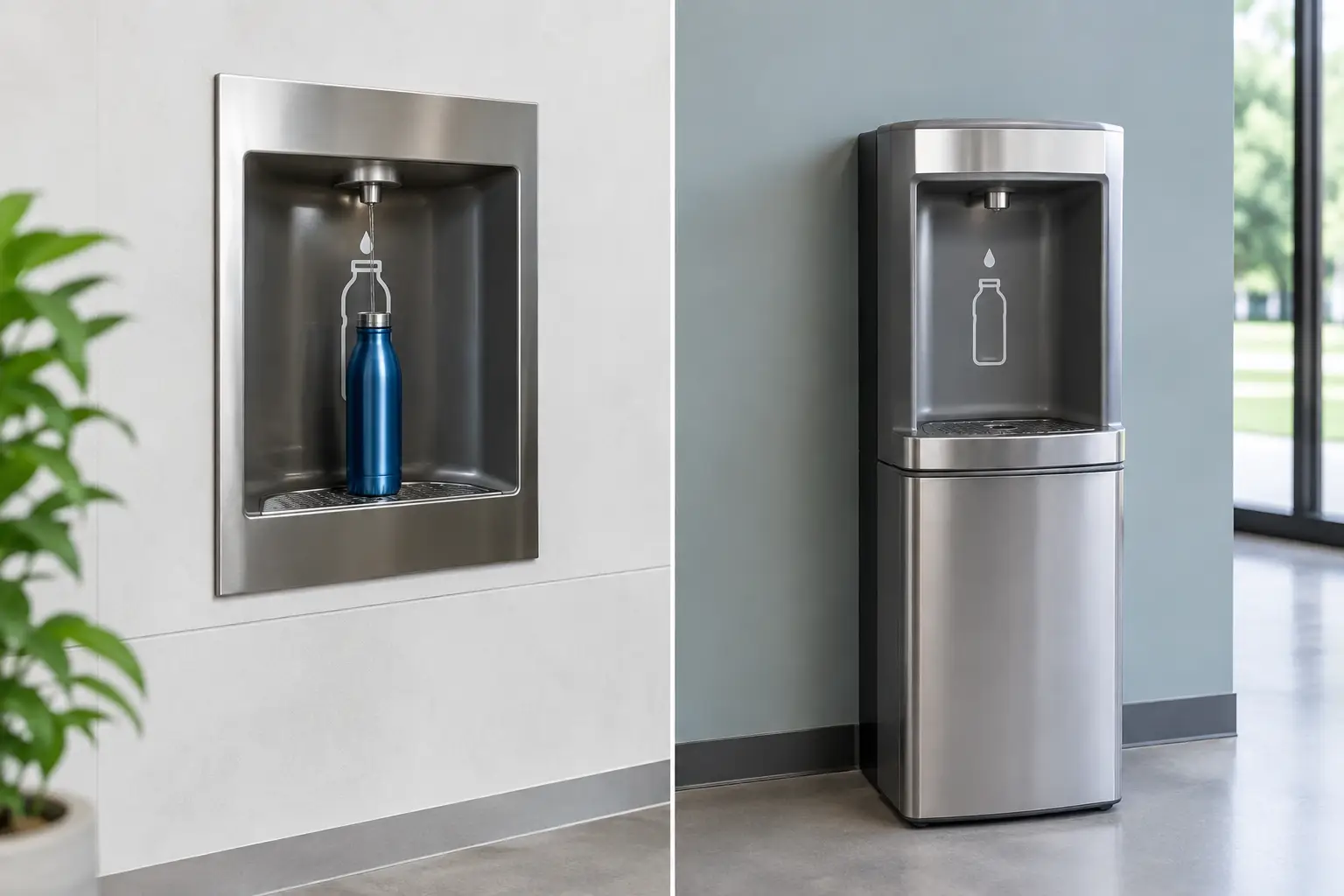
A bottle-filler decision can become a wall-condition problem, an accessibility review item, or a late-stage coordination issue if the mounting style is not settled before rough-in. When comparing recessed vs surface bottle fillers, the right choice is rarely about appearance alone. It depends on the wall assembly, traffic pattern, available utilities, accessibility requirements, maintenance access, and how much disruption the project can absorb.
For contractors, facilities teams, and procurement professionals, the practical question is simple: which unit can be installed, approved, and serviced without creating avoidable work for another trade? A surface-mounted model is often the safer answer in existing facilities. A recessed installation can deliver a cleaner profile where the wall is designed to accept it. Both can be appropriate on commercial, institutional, education, health care, government, and modular projects, provided the specification matches field conditions.
Recessed vs Surface Bottle Fillers: The Core Difference
A recessed bottle filler is set into a prepared wall opening or cabinet space so the unit face sits close to the finished wall plane. Depending on the manufacturer and model, the bottle filler may be paired with a recessed drinking fountain or installed as a dedicated filling station. The result is a lower-profile installation with fewer components projecting into a corridor or common area.
A surface bottle filler mounts on the finished wall, typically over a compatible drinking fountain, water cooler, or standalone basin assembly. The housing remains visible and projects from the wall according to the unit design. Installation generally requires less wall modification, which is a major advantage when working in an occupied building or on a renovation with limited access behind the wall.
Neither configuration is automatically better. Recessed units move more work into the wall and earlier in the schedule. Surface units move more of the assembly outward, often making them easier to place, inspect, and replace later.
Start With the Wall, Not the Product Photo
The wall construction should be reviewed before a recessed unit is selected. A recessed installation may require a framed opening, blocking, backing, waste and supply routing, electrical power, and adequate depth for the cabinet or fountain system. Those requirements are manageable in new construction when the plumbing, framing, electrical, and drywall scopes are coordinated. They can be expensive and disruptive in an existing masonry wall, a rated partition, or a wall packed with structural members, conduit, ductwork, or insulation.
Recessed equipment can also affect fire-rated assemblies. Penetrations, backing, cabinet openings, and access provisions must be coordinated with the applicable wall design and project requirements. On public-sector work, the accepted submittal does not eliminate the need for the field installation to preserve the required rating and finish conditions.
Surface-mounted bottle fillers are often the more practical selection for retrofit work because they reduce the need to open a large section of wall. That does not mean they are utility-free. The installer still needs compliant water, waste where required, power for refrigerated or electronic models, structural backing, and proper mounting height. But the amount of concealed coordination is typically lower.
For modular manufacturers, this distinction is especially important. A recessed unit can be efficient when the wall panel is built around the equipment in a controlled production setting. A surface unit may be preferable when final assembly, service access, or shipping protection drives the design. The decision should be made with the module wall build-up and connection sequence in hand.
Accessibility and Corridor Clearance Need a Project Review
Bottle-filling stations are frequently specified in schools, offices, transportation facilities, recreation centers, and government buildings where accessibility requirements are central to the design. The correct mounting height, approach, fountain configuration, operating controls, and clear floor space depend on the selected equipment and the applicable code criteria.
A recessed installation can help reduce projection into a circulation path, which may be useful in narrow corridors or high-traffic areas. Still, a recessed face does not make the entire installation compliant by itself. The drinking fountain bowl, bottle-filler housing, control location, and surrounding clearances all need review against the project documents and governing accessibility requirements.
Surface-mounted equipment deserves the same careful review. Some configurations are specifically engineered for accessible installation when mounted at the correct height and paired with the correct cooler or fountain. Others are intended as add-on units above existing fountains and may not solve a broader accessibility issue. Do not assume that a bottle filler added to an older fountain creates a compliant drinking station.
For public projects, include the mounting details, cut sheets, rough-in dimensions, and accessibility information in the submittal package early. A late rejection can affect wall finishes, piping locations, electrical work, and fixture installation dates.
Installation Cost Is More Than the Unit Price
A recessed bottle filler may carry a higher installed cost even when its product price is competitive. The project must account for framing changes, opening preparation, concealed supports, wall repair, finish work, utility relocation, and trade coordination. If the unit requires refrigeration, filtration, or a sensor-operated bottle filler, the electrical and service needs should be identified before the wall closes.
Surface-mounted models often reduce labor and wall restoration, particularly in renovations. They can also simplify replacement when an existing drinking fountain location already has usable water, drain, and power connections. However, surface equipment may require a more substantial visible assembly and may not fit the architectural intent or available corridor depth.
The lowest first cost is not always the lowest project cost. A surface unit that avoids opening a finished wall may save days of labor and prevent a shutdown in an occupied facility. Conversely, a recessed unit planned into new construction may add little incremental labor while delivering a protected, lower-profile installation.
Before releasing material, confirm these coordination points:
- Finished wall type and available cavity depth
- Required supply, waste, electrical, and filtration connections
- Mounting height, clear floor space, and fixture approach requirements
- Structural backing and manufacturer fastening requirements
- Access needs for filter replacement, refrigeration components, and future service
- Wall rating, finish details, and responsibility for patching or trim
These items are worth resolving in the preconstruction phase because they affect more than the plumbing scope.
Maintenance Access Should Influence the Specification
Facilities teams usually feel the difference between recessed and surface installations after turnover. Bottle fillers with filters, chillers, electronic sensors, and drainage components require routine access. A unit that looks clean on opening day can become difficult to maintain if a filter compartment is blocked by millwork, an access panel is omitted, or the equipment is installed too close to another wall feature.
Surface-mounted bottle fillers generally provide more direct access to the housing and service components. This can reduce maintenance time in schools, recreation facilities, plant break areas, and other locations with frequent use. It can also make damage assessment and replacement more straightforward.
Recessed units protect more of the assembly within the wall plane, but service procedures must be considered before selection. Confirm how the front panel opens, where the filter is changed, whether refrigeration components can be accessed from the front, and whether the unit can be removed without disturbing tile, wall panels, or adjacent finishes. Follow the specific manufacturer’s installation and maintenance instructions rather than relying on a generic cabinet detail.
For high-use facilities, it is also worth considering replacement-part availability, filter intervals, shutoff access, and whether maintenance staff can service the equipment without taking a corridor or break area out of use for an extended period.
When Recessed Bottle Fillers Make Sense
Recessed equipment is a strong fit when the project has adequate wall depth, a new-construction or planned-renovation schedule, and a design reason to keep the station close to the wall plane. It is commonly considered for finished corridors, institutional interiors, and locations where projection control matters.
It also works well when the project team can coordinate the opening before framing and utilities are finalized. On a large program with repeated room or corridor layouts, that early coordination can create a consistent installation standard across multiple locations.
The trade-off is less forgiveness. If rough-in dimensions are missed, wall conditions change, or service access is not protected, correcting a recessed installation can require expensive rework.
When Surface Bottle Fillers Are the Better Operational Choice
Surface-mounted bottle fillers are often the better choice for renovations, replacements, and occupied facilities where wall disruption must stay limited. They are practical when an existing fountain location can be upgraded or when the wall cavity cannot support a recessed cabinet.
They also support a faster field response when a facility needs additional hydration capacity without a full wall rebuild. In many cases, the visible profile is an acceptable trade for quicker installation, easier servicing, and fewer concealed conditions.
For schedule-driven work, the key is to verify the complete assembly. A bottle filler, fountain, mounting frame, filter, electrical requirement, and trim package may be specified or supplied separately depending on the manufacturer. Ordering only the visible component can stop installation just as effectively as ordering the wrong unit.
Build the Submittal Around the Actual Installation
Commercial bottle-filler submittals should establish more than finish, flow rate, and bottle count display. They should identify the exact model, cooling capacity where applicable, electrical characteristics, filter provisions, fountain pairing, rough-in dimensions, mounting requirements, and accessibility information needed by the project.
Government and Milcon work may require additional review of approved manufacturers, domestic-content requirements, certifications, and project-specific documentation. Procurement should verify these requirements before material is released, not after a fixture has been approved in concept but found noncompliant in documentation.
Clarke Plumbing Specialties can help project teams identify the commercial equipment and documentation needed to keep that review moving. The most useful request includes the fixture schedule, wall condition, power availability, desired installation type, and required approval criteria.
Choose the bottle filler that fits the wall, the maintenance plan, and the construction sequence – then make sure every required component is on the order before the crew reaches the installation point.