A drinking fountain is rarely the most expensive line item in a commercial plumbing package. It can still become the item that holds up an inspection, creates an accessibility correction, or generates repeat maintenance calls after turnover. The best commercial drinking fountains are the units that fit the application, meet the specified requirements, and can be installed and serviced without creating avoidable work for the field team.
For contractors, facility teams, and project buyers, the decision is not simply whether a fountain dispenses cold water. The right selection depends on traffic volume, user access, wall conditions, water quality, maintenance expectations, and the documentation required by the project. A school corridor, manufacturing floor, municipal facility, and modular restroom package may all require different answers.
What Defines the Best Commercial Drinking Fountains
Commercial drinking fountains should be evaluated as part of the building’s long-term water-access system, not as a standalone fixture. Capacity, accessibility, sanitary operation, durability, and parts availability all affect the final cost of ownership.
Start with the installation environment. High-traffic public areas need equipment that can handle frequent use without excessive recovery time or surface damage. A low-traffic administrative office may be well served by a standard wall-mounted water cooler, while a gymnasium, school, transit area, or production facility may justify a higher-capacity unit with a bottle filler.
The specification also needs to match the building’s plumbing and electrical conditions. Confirm the incoming water connection, waste requirements, electrical voltage, refrigeration requirements, mounting backing, and rough-in dimensions before material is released. A fountain that appears equivalent on a submittal can create a field issue if its mounting height, drain location, or power requirement differs from the approved design.
Capacity is more than a gallons-per-hour number
Cooling capacity is commonly expressed in gallons per hour at stated incoming-water and ambient-air conditions. That rating is useful, but it should be read in context. A unit installed in a conditioned office will not face the same demand or ambient conditions as one placed near a warehouse loading area or a school athletic space.
For a high-use location, consider the expected number of users during peak breaks rather than the total building population. A manufacturing plant may have concentrated demand at shift changes. A school may see heavy use between class periods. In either case, undersizing the cooler can lead to warm water complaints even when the unit is operating exactly as designed.
Bottle-filling stations can reduce demand at the fountain basin, but they also increase the number of users who may rely on a single fixture location. Review fill rate, bottle counter features if requested, refrigeration capacity, and filter capacity as a complete system.
Accessibility must be coordinated, not assumed
ADA-compliant drinking fountain installations are typically built around accessible user heights, clear floor space, knee and toe clearance, controls, and forward approach requirements. The fountain itself is only one part of that compliance path. Mounting height, wall projection, surrounding circulation, and the configuration of high and low units all matter.
A bi-level installation may be the best fit where the project requires access for both standing users and wheelchair users. It can save wall space compared with separate installations, but it requires careful rough-in coordination. In renovation work, existing wall framing, piping locations, and available clearances may make separate units or an alternate configuration more practical.
Do not rely on a product name alone to establish compliance. Review the approved cut sheet, installation instructions, project accessibility criteria, and applicable local requirements. For government and Milcon work, document control is especially important because substitutions, finish changes, and component revisions may require formal review before purchasing.
Choosing Fountain Types by Application
The best commercial drinking fountains for a project are usually selected by use case first, then narrowed by capacity, finish, options, and approved manufacturer requirements.
Standard wall-mounted water coolers
A standard refrigerated wall-mounted cooler remains a practical choice for offices, small public areas, employee break zones, and locations with moderate use. These units are familiar to maintenance teams, generally straightforward to service, and available in configurations suited to common commercial rough-ins.
Their limitation is throughput. Where many users arrive at once, a standard cooler may not provide enough chilled water recovery. It also may not meet owner expectations when bottled-water use is common. Evaluate the actual traffic pattern before treating the standard unit as the default.
Bottle-filling stations with fountains
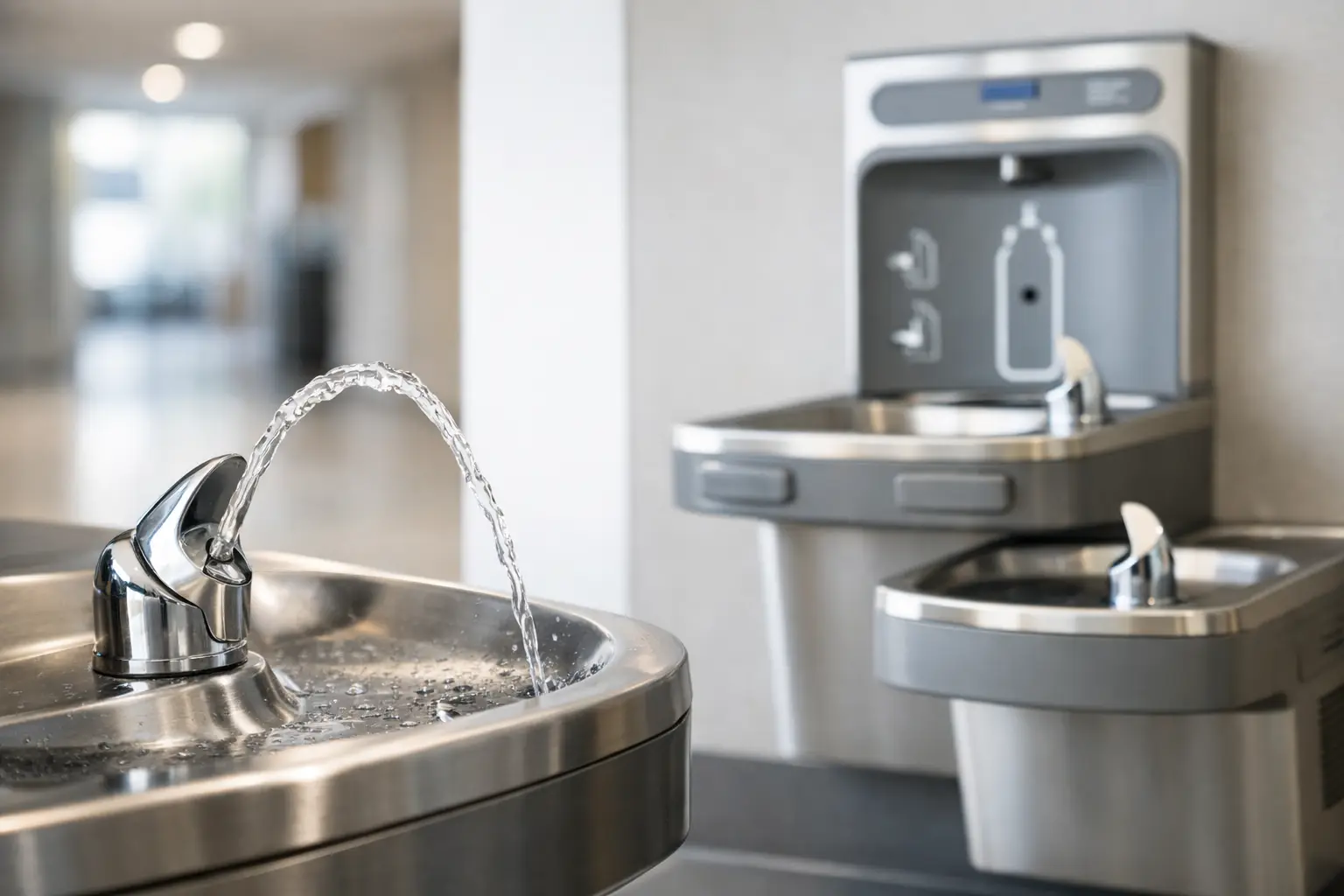
Combination bottle fillers and drinking fountains are widely specified in schools, healthcare settings, offices, recreation facilities, and public buildings. They provide traditional access to a drinking basin while supporting refillable bottles, which can reduce disposable bottle waste and keep users moving through busy corridors.
The trade-off is added complexity. Bottle fillers introduce electronic components, sensors, filter monitoring, and potential power requirements that must be planned for. If filtration is included, the facility needs a clear replacement schedule and a source for approved cartridges. A filter status light is helpful, but it does not replace an established maintenance process.
Non-refrigerated fountains
Non-refrigerated fountains are appropriate where chilled water is not required, where refrigeration adds unnecessary maintenance exposure, or where the building has limited electrical access. They can be a sensible choice for some industrial, seasonal, outdoor-protected, or budget-controlled applications.
The water temperature will follow supply and environmental conditions. In a warm climate or heated mechanical environment, that may not meet user expectations. Specify them intentionally, not as a cost-cutting substitute for a cooler in a high-demand public space.
Outdoor and vandal-resistant units
Parks, campuses, transit-adjacent spaces, and exterior recreation areas need units built for weather exposure and hard use. Freeze resistance, corrosion-resistant materials, recessed controls, protected components, and durable mounting are more important here than a polished appearance.
Outdoor equipment requires site-specific review. Drainage, winterization, water shutoff access, foundation or slab conditions, and local freeze conditions can determine whether a unit performs reliably. A vandal-resistant model can reduce damage risk, but it cannot compensate for poor installation or an unprotected water supply in freezing weather.
Specifications That Prevent Jobsite Problems
A compliant fountain is not automatically the correct fountain. Before ordering, compare the approved submittal against the actual project conditions and identify every accessory or field requirement needed for a complete installation.
Key checkpoints include:
- Refrigerated or non-refrigerated configuration and required cooling capacity
- Single, bi-level, barrier-free, or bottle-filler arrangement
- Electrical requirement, cord or hardwire condition, and disconnect responsibility
- Water supply size, waste connection, trap requirements, and shutoff access
- Filter package, replacement cartridge, and maintenance indicator requirements
- Finish, basin material, vandal-resistant options, and exterior-use suitability
- Lead-free, material, safety, and drinking-water certifications required by the contract
- Approved manufacturer, model number, substitutions policy, and submittal status
This level of review matters most when fixtures are purchased in volume. A modular manufacturer may need repeated, identical assemblies delivered to a production schedule. A contractor may need fixtures released by floor, wing, or building phase. A public-sector buyer may need complete product data and approval records before a purchase order can move forward. In each case, a small mismatch becomes more costly when multiplied across the job.
Plan for Service Before Turnover
Facilities teams inherit the operating consequences of the original specification. A fountain with difficult filter access, unavailable parts, or a nonstandard control assembly can turn routine maintenance into repeated downtime.
For long-term serviceability, favor commercial equipment with identifiable replacement parts and accessible service areas. Confirm how filters are changed, whether the refrigeration system can be serviced in place, and whether the installation leaves enough clearance for maintenance. In a tightly framed chase or modular wall assembly, those details should be resolved before fabrication.
Water quality should also influence the selection. Sediment, scale, chlorine, and local water conditions can affect flow, taste, filter life, and component performance. Filtration can improve the user experience, but it creates an operating commitment. A facility that cannot maintain filters on schedule may be better served by a simpler configuration or a documented service plan.
Sanitary performance deserves the same practical approach. Touchless bottle filling can reduce contact at a high-use station, while protected bubblers and easy-clean surfaces help support routine custodial work. These features are useful when they align with the facility’s cleaning practices and maintenance capacity.
Buy the Complete Approved Assembly
A drinking fountain package can involve more than the visible fixture. Depending on the model and project, the complete requirement may include a filter, mounting plate, carrier, valve, trim, electrical connection components, freeze-protection accessories, or replacement cartridges. Omitting one item can leave an otherwise delivered fixture waiting on a small but necessary component.
For schedule-sensitive work, procurement should verify the approved model, current availability, lead time, accessory requirements, and documentation before installation dates are fixed. If a specified product is unavailable, identify acceptable alternatives early enough for review rather than presenting a substitution when the rough-in is already complete.
Clarke Plumbing Specialties supports commercial buyers who need that level of material coordination, particularly when approved documentation, recurring fulfillment, or difficult sourcing is part of the job. The objective is straightforward: get the correct equipment and supporting components to the project before a missing item affects labor, inspection, or turnover.
The right drinking fountain is the one that performs under the building’s real traffic conditions, fits the approved installation, and remains serviceable after the project team has left the site. Make that decision early, verify the full assembly, and give the field team a fixture package they can install without chasing parts.