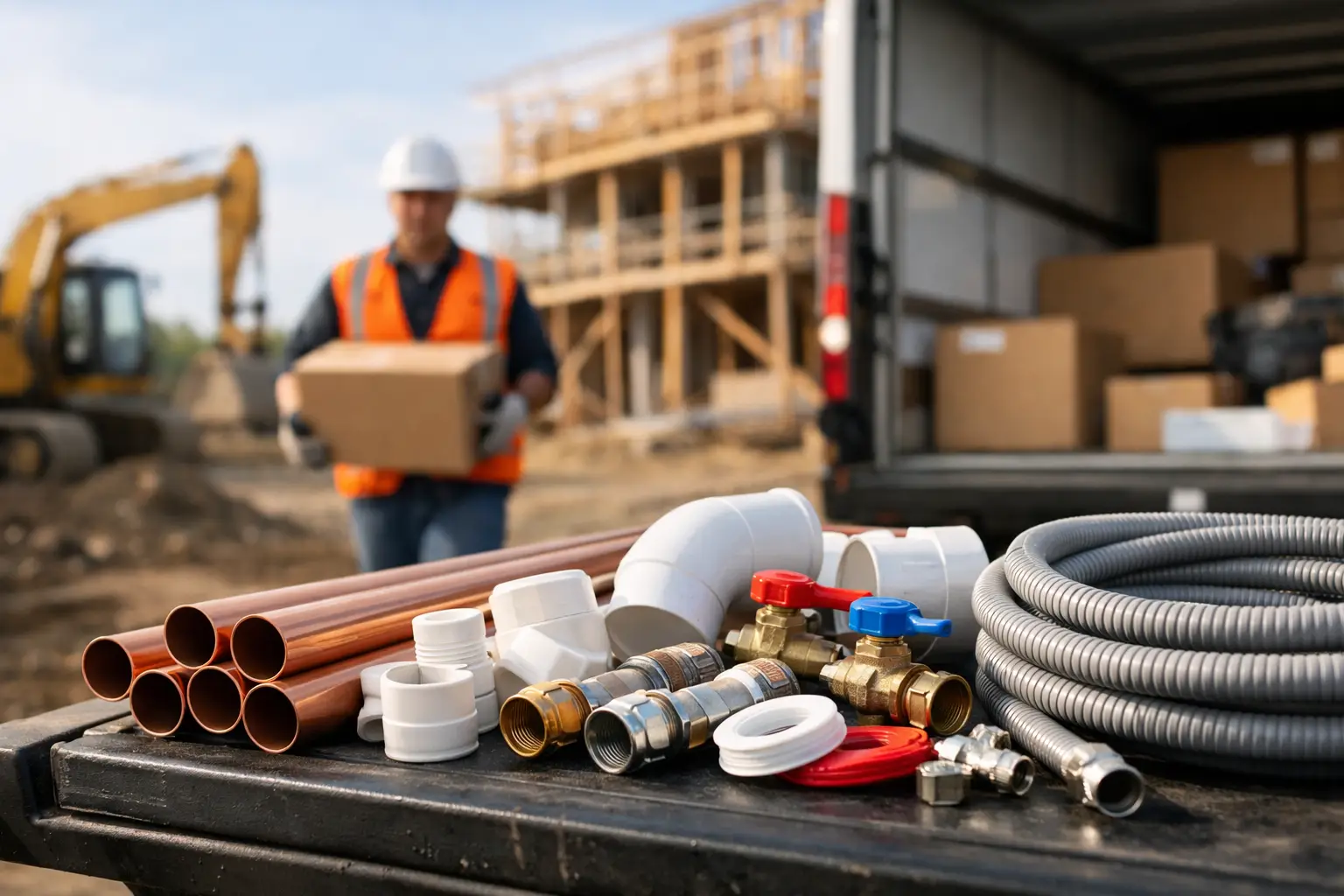
A foreman finds the missing item at 6:40 a.m.: a specified drain body, the correct copper fitting, an approved bottle-filling station component, or a water-heater accessory that cannot be swapped without consequences. The crew is present, the work area is open, and the next trade is scheduled behind them. Urgent jobsite plumbing materials are not simply a rush-order problem. They are a schedule, specification, documentation, and delivery problem happening at the same time.
For commercial contractors, modular manufacturers, facilities teams, and government-project buyers, the cost of a missing component is rarely limited to the purchase price. It can mean idle labor, a missed inspection, an interrupted production line, remobilization costs, or a delayed turnover date. The right response starts with getting clear on what is actually needed before anyone starts calling suppliers.
Start With the Exact Material Requirement
Speed matters, but guessing is expensive. A request for a 2-inch drain, a mixing valve, or a drinking fountain can describe dozens of products with different rough-in dimensions, connection types, finishes, flow requirements, and compliance designations. A material that arrives quickly but does not fit the application is not an urgent solution.
Provide the manufacturer and model number when available, along with the relevant submittal, bill of materials, or drawing detail. If the original product is unavailable, the supplier needs enough information to evaluate an equivalent without creating a field problem. That includes pipe size and material, pressure and temperature requirements, connection method, voltage and phase for electric equipment, mounting configuration, and any project-specific code or accessibility requirements.
Photos help when the need is a replacement part or an existing-condition repair. A clear image of the label, connection, surrounding installation, and failed component can prevent a wrong assumption. For equipment such as hand dryers, instantaneous electric water heaters, bottle fillers, and flush valves, include the serial number where applicable. Small details often determine whether the replacement can be installed that day.
Confirm What “Urgent” Means on This Job
Not every urgent request needs the same fulfillment plan. Sometimes the crew needs material at the gate before noon. Other times, a specific item is needed within two days to protect a concrete pour, a ceiling close-in, an inspection, or a factory assembly sequence. State the actual need-by time, receiving restrictions, jobsite contact, delivery address, and whether will-call is workable.
This gives the supply team a practical decision framework. They can check local inventory, warehouse availability, manufacturer stock, expedited freight options, or acceptable alternate configurations instead of treating every request as an undefined emergency. It also helps the project team decide whether labor can be redirected while material is in transit.
How to Source Urgent Jobsite Plumbing Materials Without Creating Rework
The fastest path is usually the one with the fewest handoffs. A complete request allows a wholesale supply partner to verify availability, confirm product compatibility, obtain pricing, and arrange delivery without repeatedly returning for missing information. On a large project, that discipline becomes especially valuable because a single incomplete line item can hold up a larger release.
Begin by separating standard commodity material from specification-critical equipment. Common copper tubing, fittings, valves, drains, and repair parts may have several workable sourcing paths, depending on project requirements. Specified fixtures, accessible shower systems, institutional equipment, and engineered water-heating products generally need a closer review. The original manufacturer may be required, the project may call for a listed performance standard, or installation dimensions may make a substitution impractical.
A legitimate equivalent must do more than resemble the unavailable product. It must meet the intended duty, fit the rough-in, work with connected systems, satisfy the specification, and be accepted by the authority having jurisdiction or project approval process when required. In some cases, waiting for the specified product is less costly than installing an alternate that triggers engineering review, rework, or a failed inspection.
That said, an approved alternate can protect a schedule when handled correctly. Ask for comparison data that addresses the points the project team will evaluate: dimensions, materials, operating performance, certifications, electrical characteristics, warranty, finish, and maintenance considerations. Keep the approval trail with the purchase documentation. Field personnel should not be asked to defend an unreviewed substitution after it is already installed.
Watch the Accessories That Stop Installation
Many urgent material shortages are not the primary fixture or equipment package. They are the accessory, trim, adapter, mounting carrier, stop valve, repair kit, connector, escutcheon, sensor component, or electrical requirement that was missed in the original takeoff. The main item may be on site, but it cannot be installed or commissioned without the missing piece.
Before releasing a rush order, review the installation package as a system. For drinking fountains and bottle fillers, verify the cooler, filtration components, mounting hardware, drain connection, electrical requirements, and compatible accessories. For electric water heaters, confirm voltage, phase, breaker sizing, mounting needs, and unions or valve assemblies. For accessible showers, check the valve, trim, grab-bar layout, drain arrangement, and required backing or support components.
This review does not need to slow the order down. It should be a focused check performed while inventory is being confirmed. A responsive supplier can help identify related items that are commonly overlooked, but the project team remains responsible for confirming field conditions and contract requirements.
Documentation Is Part of the Delivery
On commercial and public work, material cannot always move directly from availability to installation. Submittals, cut sheets, certifications, domestic-preference requirements, approvals, and project-specific documentation may control whether an item can be purchased or accepted. For military construction and US Government projects, this is often the difference between a usable source and a dead end.
Send the applicable specification section, approved submittal reference, and procurement requirement at the start of the request. If the project requires a particular country of origin, manufacturer authorization, certification, or compliance statement, identify it before the supply team spends time locating material that cannot be approved. The same applies to substitutions. An alternate that can ship tomorrow may still be unusable if its documentation does not support the project requirement.
Clarke Plumbing Specialties supports this process by pairing material sourcing with the job information, approval processing, and submittal support that regulated projects demand. That approach matters when a buyer needs more than a box on a truck. They need a defensible material package that can move through the project process.
Build a Better Rush-Order Request
A short, complete request improves response time and reduces the chance of a bad release. Include the product description and quantity, manufacturer and model if known, the required delivery time, job name and location, receiving contact, and any documents that govern acceptance. Note whether a partial shipment helps or hurts. On some jobs, receiving available material immediately allows rough-in work to continue; on others, split shipments create handling issues or make staging more difficult.
Be direct about flexibility. If only the specified product will work, say so. If a listed equivalent, alternate finish, or different packaging quantity is acceptable with approval, state the boundaries. Suppliers can move faster when they know where they have room to solve the problem and where they do not.
For recurring construction programs and assembly-line operations, keep a live list of long-lead and high-risk plumbing materials. Review it at release, before rough-in, before finish, and ahead of commissioning. This is not extra paperwork for its own sake. It is a practical way to find the small components that can stop a large operation.
When Freight Speed Is Not the Only Decision
Expedited freight is useful, but it should be weighed against the cost of the delay and the reliability of the delivery plan. A same-day courier may be the right answer for a repair part holding up a facility, while overnight service may be enough for a next-day inspection. For heavy fixtures, long copper lengths, or large equipment, freight handling, site access, and damage risk can matter as much as transit time.
Confirm who can receive the shipment, whether the site has unloading capability, and whether delivery must be scheduled around security, union, school, hospital, or government-facility rules. A truck arriving at a closed gate is not a successful rush delivery. If the material is critical, establish a named contact who will verify receipt and inspect for visible damage immediately.
The next time a plumbing item threatens the schedule, treat the request as a field execution issue, not just a purchasing task. Bring the exact requirement, the approval constraints, and the real delivery deadline into the first conversation. That gives the supply team the information needed to persist until a workable path is found – and gives your crew a better chance of staying productive.